
I often see the names of ancient Greek heroes in literature and the arts, and I'm not always sure who they are. To bone up on the subject, I read "Heroes: The Greek Myths Reimagined" by Stephen Fry - an actor, comedian, and writer who puts a fun spin on Greek mythology.

In this book, Stephen Fry relates the adventures of Perseus, Heracles, Bellerophon, Orpheus, Jason, Atalanta, Oedipus and Theseus. The Greek myths involve hundreds of people, gods, and heinous beings, and Fry includes many of them in this narrative - with a handy glossary and index at the back, along with footnotes for further clarification.
In this review, however, I'll just say a little about each swashbuckler, and provide a glimpse of Fry's humor and wry observations.
🗡️🗡️ Perseus: A prophecy led to baby Perseus and his mother Danaë being cast into the sea in a wooden box.
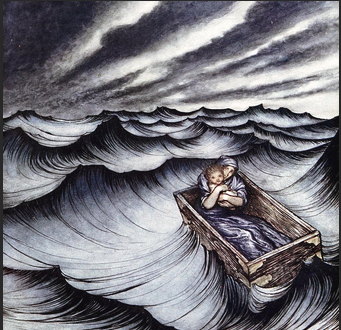
Perseus and Danaë cast into the sea
Perseus and Danaë were rescued, and Perseus grew up to be a brave young man who was 'tricked' into obtaining the head of Medusa. After Perseus agreed to bring back Medusa's head, he consulted his mother.
P: Mum, what's a Medusa?
M: She's a Gorgon, a dreadful creature with boar's tusks instead of teeth, razor sharp claws of brass, and venomous snakes for hair.
P: Get away!
M: That's the story.
P: Right....and if....say, for example....someone was to go hunting for her?
M: They'd be a fool. One glance from her will turn you to stone. If you were to meet her eyes for just one second you would be petrified.
P: Scared?
M: No, petrified means turned to stone. Like a statue.
P: Oh. so THAT'S Medusa? I'd rather hoped she might turn out to be some of giant chicken, or a pig maybe.
Perseus goes on to have a series of adventures, one of which is cutting off Medusa's head.
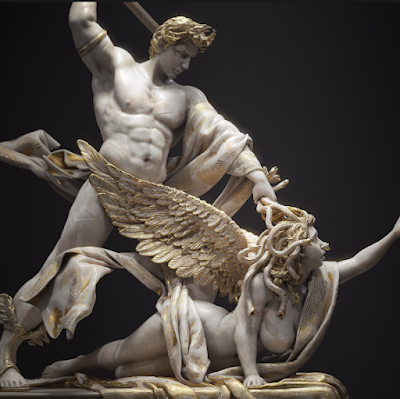
Perseus and Medusa
🗡️🗡️ Heracles: Heracles was the son of Zeus and Alcmene, which infuriated Zeus's wife Hera. Hera took out her spite on young Heracles, and duped him into killing his wife and two sons. To expiate his guilt, Heracles had to perform twelve tasks for King Eurystheus - who was jealous of Heracles reputation as the tallest, broadest, strongest, fastest young man in the world.
Heracles' tasks included killing the Nemean Lion, slaying the Hydra, bringing back the golden hind (deer) of Ceryneia, capturing the Erymanthian Boar, and so on.
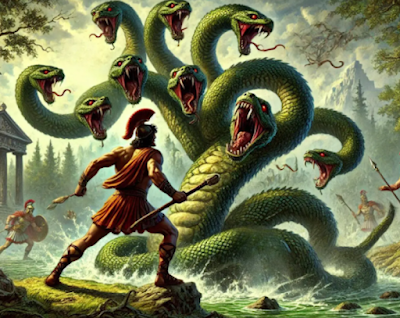
Heracles and the Hydra
When Heracles returned with the live Erymanthian Boar, Eurystheus was so terrified of the enormous beast that he leapt into a great stone jar and cowered there, saying "Take it away....Take it away NOW!" The scene is a favorite among Greek pot painters, who loved to depict the frightened Eurystheus cringing in his jar while Heracles threatens to drop an enormous squirming pig down on top of him.
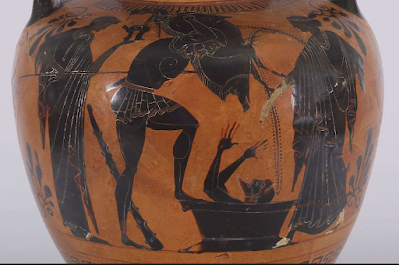
Heracles holds the Erymanthian Boar over Eurystheus, cowering in his stone jar
🗡️🗡️ Bellerophon: Bellerophon tamed the winged horse Pegasus, and crowds came to watch him ride the white horse through the sky. When Bellerophon spurned the advances of a married woman called Stheneboea, the wrathful female told her husband that Bellerophon tried to force himself on her. In a roundabout way, this resulted in Bellerophon performing a series of tasks for King Iobate. These tasks entailed killing the fire-breathing Chimera, subduing the Solymi raiders, taming the Amazon warriors, and more.
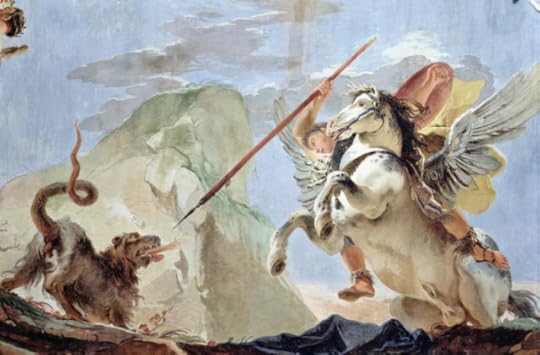
Bellerophon on Pegasus fighting the Chimera
Author Stephen Fry writes, 'It gives me no pleasure to relate that Bellerophon's youthful cockiness soured over the years into a very unappealing arrogance and vanity. Such hubris was a blasphemy that could not go unpunished, and [condemned by Zeus] Bellerophon died a crippled, embittered, and lonely old man.' 😪
🗡️🗡️ Orpheus: In the words of Stephen Fry, 'Orpheus was the Mozart of the ancient world. He was more than that. Orpheus was the Cole Porter, the Shakespeare, the Lennon and McCartney, the Adele, Prince, Luciano Pavarotti, Lady Gaga, and Kendrick Lamar of the ancient world, the sweet-singing master of worlds and music'.
Orpheus is known for his many adventures, in the midst of which he married beautiful Eurydice. When Eurydice died from a snake bite, Orpheus put aside his lyre and vowed never to sing again.
Apollo convinced Orpheus to enter the underworld to bring Eurydice back. When Orpheus encountered Hades and Persephone - the King and Queen of the dead - he charmed them with his music and Hades gave permission for Eurydice to depart. Hades told Orpheus, 'Leave us. Eurydice will follow. But if you turn round to look at her before you reach the mouth of the cave, you will lose her.' Sadly, Orpheus turned a moment too soon and lost Eurydice forever.
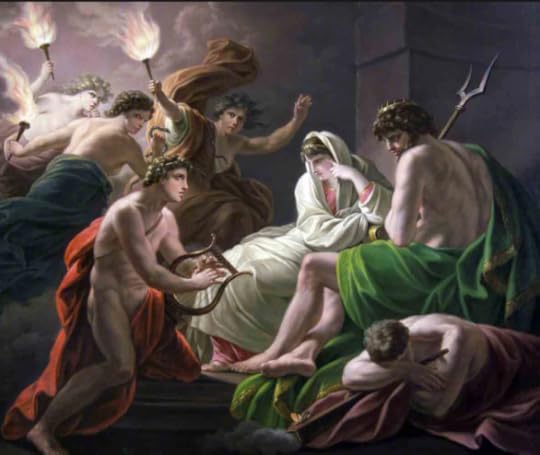
Orpheus plays his lute for Hades and Persephone
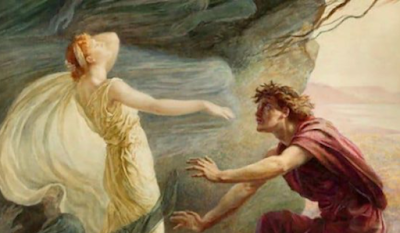
Orpheus looks back at Eurydice too soon
🗡️🗡️ Jason: Jason is famous for his voyage on the Argo to retrieve the Golden Fleece from Colchis (today the Republic of Georgia) and bring it back to Greece. When Jason was preparing for his crusade, word went out that a party of heroes was required to crew the Argo and help win eternal glory. Some of the best-known figures of the Greek world became Argonauts, including Heracles and Orpheus.
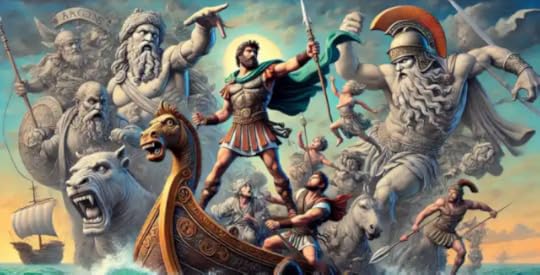
Jason and the Argonauts
Stephen Fry observes, 'It is generally held that, in historical ancient Greece, many grand families laid claim to Argonaut ancestors. Over the generations, poets and historians were paid to include such ancestors in 'definitive' accounts of the voyage in order to lend prestige to the pedigrees of the rich and powerful'.
In any case, Jason and the Argonauts' long quest was filled with all manner of danger and adventure, not least because the Golden Fleece was guarded by a fierce serpent that never slept or closed its eyes.
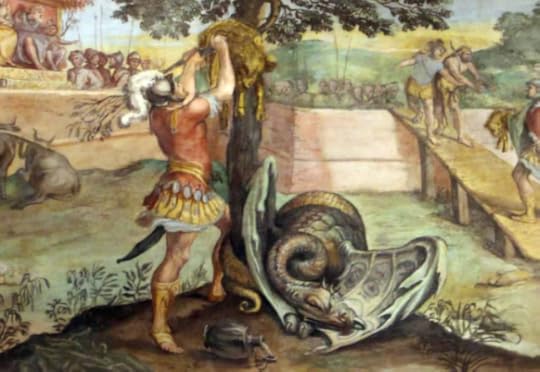
Jason taking the Golden Fleece
🗡️🗡️ Atalanta: Atalanta was born to an Arcadian king who had no use for female offspring. The king had the baby left on a mountaintop to die, but a bear found the outcast and raised her. Later, the child was taken by a group of hunters who named her Atalanta, and 'taught her the secrets of trapping and killing, of shooting with arrows, spears, and slings, coursing, hunting, tracking, and all the arts of venery and the chase'.
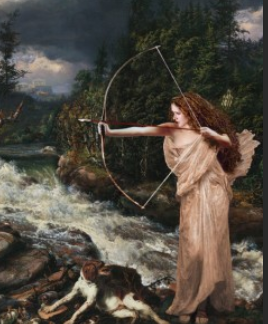
The huntress Atalanta
Atalanta was dedicated to Artemis, the goddess of wild animals and chastity. When the citizens of Calydon disrespected Artemis, she cursed the city with a monstrous boar that had razor-sharp tusks the size of tree branches, and an insatiable appetite for livestock. The boar trampled the crops, ravaged the vineyards and barns, and like the rats in 'The Pied Piper of Hamelin', bit the babies in their cradles and drank the soup from the cooks' own ladles.
A call for hunters went out, to conquer the Calydonian Boar during the Calydonian Hunt led by Meleager. Many Greek heroes volunteered, but when Atalanta showed up, some men shouted with derision. They said things like:
Girls can't throw.
Girls can't run in a straight line without bumping into trees or tripping over.
Girls can't shoot arrows without the bowstring snapping back and stinging them in the face.
Girls don't have the stomach to kill.
Atalanta proved them all wrong and was instrumental in killing the boar. Atalanta then went on to additional exploits.
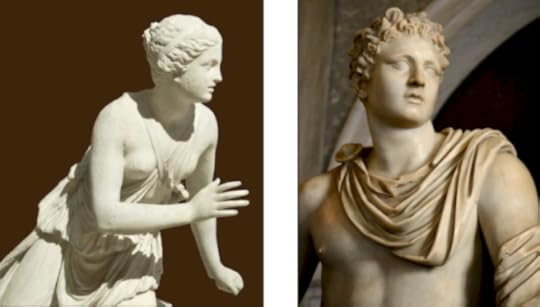
Atalanta and Meleager
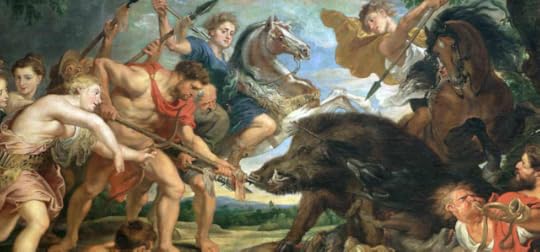
The Calydonian Boar Hunt
🗡️🗡️ Oedipus: After a Delphic oracle proclaimed that the son of King Laius and Queen Jocasta would kill his father, a baby son was born to the couple. Laius told his most trusted servant, 'Take this baby and expose it on the highest point of Mount Cithaeron, and just to be sure, stake him to the hillside. I don't want him crawling away'.
A shepherd rescued the infant and the child was adopted by King Polybus and Queen Merope of Corinth, who called him Oedipus. As far as Oedipus knew, Polybus and Merope were his parents, and he was a true prince.
When Oedipus visited the Oracle at Delphi, he was told, 'Oedipus will kill his father and mate with his mother.' Stunned, Oedipus knew he must never see Polybus and Merope again. The risk of harming Polybus through some accident was too great. And as for marrying his mother....the idea made him feel physically sick. He was very fond of his mother, but in that WAY?
On his subsequent wanderings, Oedipus had a fatal confrontation with his REAL father Laius. Oedipus then answered the riddle of the Sphinx, and was allowed to pass the crossroads where she stood. Afterwards, Oedipus met and married his REAL mother Jocasta. Years later, when Oedipus learned what he had done, he pulled the long gold brooch pins from Jocasta's dress and thrust them into his own eyes.
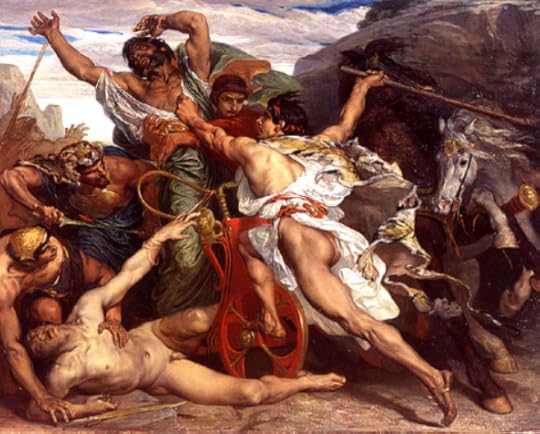
Oedipus kills Laius
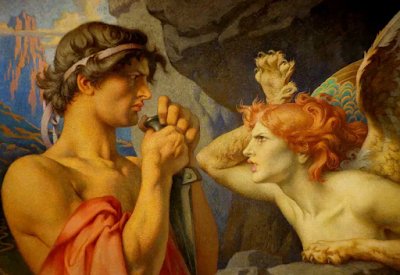
Oedipus answers the riddle of the Sphinx
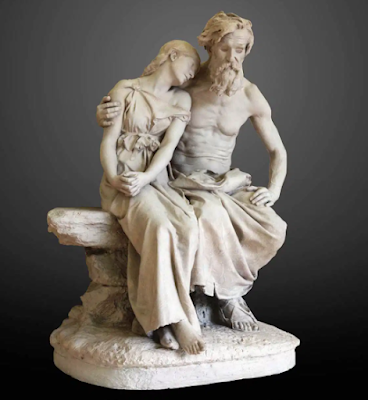
Oedipus and Jocasta
🗡️🗡️ Theseus: When Theseus moved an 'immovable' boulder in his home city of Troezen, he found a pair of sandals and a silver sword left by his (until then) unknown father, King Aegeus of Athens. Theseus's mother urged him to go to the Athenian court to meet old Aegeus, saying 'He'll be so tickled! You know he married Medea of Colchis. Terrifying woman by all accounts. A sorceress and murderer of her own close kin. I'll hunt out a present for you, a little treasure of some kind you can give them both with my regards'.
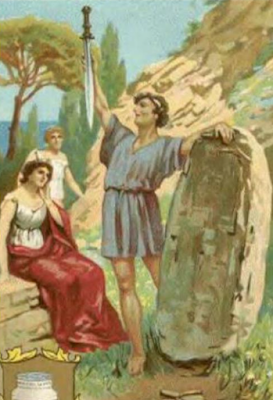
Theseus moves the boulder to find sandals and a sword
Theseus decided to travel to Athens by foot, a long, arduous, dangerous journey that resulted in the Six Labors of Theseus. These included killing the one-eyed giant Periphetes; confronting Sinis the bender; defeating the Crommyonian Sow; and more.
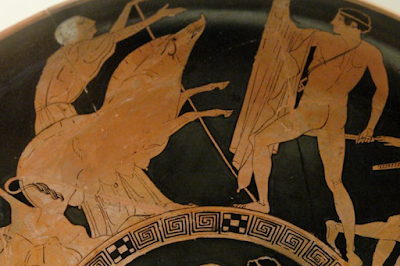
Theseus confronts the Crommyonian Sow
Theseus finally arrived in Athens, where he was heir to the throne, but had many rivals and enemies. Queen Medea was especially anxious to do away with Orpheus because she wanted her son to rule Athens. Thus Orpheus was given a series of deadly tasks, which he completely successfully.
Later, Theseus defeated the Minotaur in the maze, for which he's renowned. Theseus became the King of Athens, and the Athenians viewed Theseus as the inventor of wrestling. bull-leaping, democracy, and justice - as well as being a paragon of intelligence, wit, insight, and wisdom.
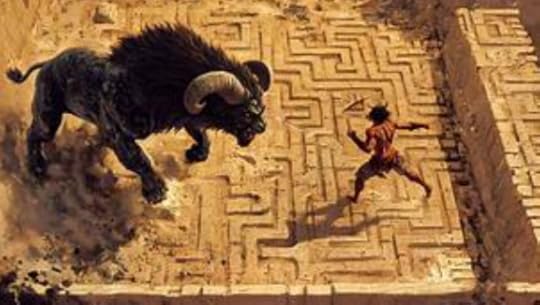
Theseus defeats the Minotaur in the maze
In mythology, 'the heroes cleansed our world of monsters like dragons, giants, centaurs, and mutant beasts that infested the air, earth, and seas. This permitted humans to spread out with confidence and transform the wild world into a place of safety for humanity'. (Ha ha ha)
The book is a lively overview of some better known Greek heroes, with descriptions of their complicated lineages, interwoven family relations, and the nefarious creatures in their midst. Tangential anecdotes add enlightenment to the book, making this a good introduction to Greek folklore. Highly recommended.
Stephen Fry has penned additional books on Greek mythology, in his inimitable entertaining fashion. Fry's love for the subject, and vast knowledge, is obvious and admirable. 👍
Rating: 4 stars

No comments:
Post a Comment