
In this 4th book in the 'Alex Morrow' series, the Detective Inspector investigates several crimes in Glasgow. The book can be read as a standalone.
*****
This Scottish mystery begins in 1997, on the night Princess Diana died. Fourteen-year-old Rose Wilson is out with her pimp Sammy who regularly rents her out to groups of older men.

On that fateful night, however, Rose kills two people and promptly surrenders to the police.

Her appointed lawyer, Julius Macmillan, sees potential in Rose and makes arrangements to insure that she gets a light prison sentence and a job when she gets out.

Skip to the present and Detective Inspector Alex Morrow is questioning Michael Brown, an ex-con who has been arrested for having illegal weapons. Brown is a hardened criminal who was previously imprisoned for murdering his brother.

Meanwhile, Julius Macmillan has just died and his son Robert has disappeared after giving the authorities evidence of his father's illegal activities. Also dead is a Pakistani man, Aziz, known for his charitable work. And big surprise, Michael Brown - who was in jail at the time of death - seems to have left his fingerprints at the Aziz murder scene.

Clearly something isn't kosher in Glasgow. The complex plot alternately focuses on Rose Wilson, Robert Macmillan, and Alex Morrow - so we see what's going on with each of them in mind and body. The reader needs to pay close attention to hold on to all the story threads but it's worth the effort.
Denise Mina gives us a fascinating (presumably fictional) glimpse of Glasgow's underbelly of bad cops, shady lawyers, murderous gangsters, child molesters, and other unsavory folks. It's a good mystery, but not a light read.
Rating: 4 stars


In this 11th book in the 'Lincoln Rhyme' series, the quadriplegic forensic scientist is after a sadistic serial killer who kills with poison tattoos. The book can be read as a standalone.
*****
A serial killer is plaguing New York City. He creeps through the disused underground infrastructure of Manhattan which (unknown to most people) connects with the basements of various retail shops, restaurants, hospitals, office buildings, etc.

Once the murderer snags a victim he tattoos him/her with poison ink, resulting in an excruciatingly painful death. The tattoos contain numbers and seem to be conveying a message, but the meaning is inscrutable.

On the killer's trail is famous quadriplegic crime scene investigator (CSI) Lincoln Rhyme and his team.

Rhyme's assistant, NYPD detective Amelia Sachs, trawls through crime scenes collecting evidence, which is analyzed in Rhyme's state of the art forensic laboratory.

Rhyme believes this new serial killer has been inspired by a deceased serial killer, called 'The Bone Collector'.
Meanwhile, another murderer Rhyme helped apprehend, called 'The Watchmaker', has recently died in prison. Hoping to uncover 'The Watchmaker's' associates, Rhyme sends rookie cop Ron Pulaski, undercover, to see who picks up the cremation remains. At the funeral parlor the inexperienced rookie bumbles around a bit, but manages to meet a person of interest.

Wanting to learn as much as possible about tattooing Rhyme interviews an expert and gets a quick education in 'body modification', which helps the CSI profile the killer.

This and other clues allow Rhyme's team to track the perp and to foil some attacks, but the killer always manages to get away. The murderer - who seems to be preternaturally clever and capable - is infuriated by this interference and targets Rhyme and his crew.
While this is going on Amelia has an additional worry. Nineteen-year-old Pamela, a girl with a horrible childhood that Amelia took under her wing, wants to quit college and travel the world with her boyfriend Sean.

Arguments over this drive a wedge between the women and distract Amelia.
The story is told in alternating sections, from the point of view of the killer and the point of view of Rhyme and his associates. The reader learns that the killer, named Billy Haven, is following instructions in a detailed manifesto and that his ultimate objective is bigger than just killing people with poison tattoos.

The story is skillfully told, with twists I didn't anticipate. On the down side, the complexity of the scheme that drives the plot REALLY REALLY strains credulity.
I have a couple more quibbles with the Lincoln Rhyme series as a whole. First, in every book the serial killer goes after the CSI and his associates, which seems unlikely to happen in real life. (Just as an aside, this also bothers me about Patricia Cornwell's 'Dr. Kay Scarpetta' series, where the serial killer always targets the medical examiner and her family/friends.)
Second, the Rhyme books have an 'incestuous' feel since we hear about the same serial killers time after time. Though this story is about Billy Haven (the tattooer), we also read a lot about 'The Bone Collector' and the 'The Watchmaker'. I kind of wish Jeffrey Deaver would let these guys rest in peace.
Reservations aside, the book is an exciting page turner with a wide array of interesting characters. Reading previous books in the series would be preferable, but the book works okay as a standalone. Recommended for mystery fans, especially people who enjoy the Lincoln Rhyme series.

Rating: 4 stars

This is the third book in the "Remembrance of Things Past " science fiction trilogy by Cixin Liu.
SPOILER ALERT / SPOILER ALERT / SPOILER ALERT
If you haven't read the first two books in the trilogy this review will contain spoilers.
Each book in the trilogy has an intricate multilayered plot, numerous scientific concepts (real and made up), and a slew of interesting, complex characters. However, in a nutshell.....
In book one - The Three-Body Problem - extraterrestrial beings called Trisolarans, from the planet Trisolaris, learn about the existence of Earth. Trisolaris is a volatile planet with hostile living conditions, so the Trisolarans announce their intention of sending a fleet to take over Earth, a trip that will take 400 years.

By the end of book two - The Dark Forest- both humans and Trisolarans have learned that advanced civilizations in the universe will wipe out any planet that shows signs of intelligent life (presumably for self-protection). So a human scientist's threat - and demonstrated ability - to broadcast the location of Trisolaris to the cosmos convinces the approaching Trisolaran fleet to alter its course....away from us. However there's a fly in the ointment: once the 'destroyers' have wiped out Trisolaris they'll inevitably discover Earth - which is very close (in astronomical terms).

As the third book - Death's End - opens, the first Trisolaran fleet has moved away from the Solar System and Earth is in the 'Deterrence Era.' That is, the alien invasion has been deterred by the above mentioned threat of exposure. Humans are doing pretty well: governments are democratic; Trisolaran knowledge - shared with Earth - has led to remarkable advances in science and technology; human habitats and industries have spread through the Solar System; people have comfortable homes, fashionable clothes, and graceful manners; etc. Everything seems hunky dory.

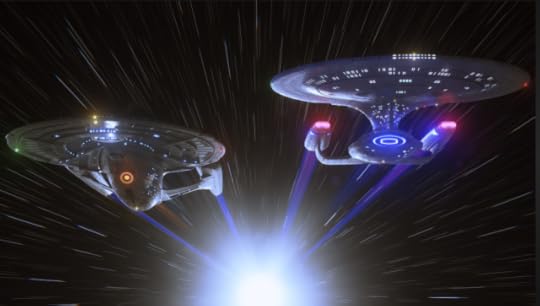
For reasons explained in a previous book, four spaceships have left the Solar System. The first two ships harbor 'escapists'; people who - following a battle with mysterious 'droplets' - 'escaped' out into the galaxy.....which is forbidden by law. The other two ships are in pursuit, trying to catch the runaways. At one point, some of these ships encounter a four-dimensional fragment of space that has remarkable properties.
Meanwhile, back on Earth humans remain on alert. Though the Trisolarans seem to be behaving themselves they're still potential hostiles. Thus a human scientist, called the 'Swordholder', is in charge of a 'doomsday button' that will immediately broadcast the location of Trisolaris if the aliens mount a surprise attack.

The question is....will the Swordholder have the guts to push the button, knowing it will eventually lead to Earth's destruction. I liked the suspense in the book so I don't want to give too much away. Let's just say - somehow or other - the location of Trisolaris is exposed.
After Trisolaris is unmasked humans fear total annihilation. So Earth scientists propose potential survival strategies: one plan is to hide all humans in structures behind the four outer planets;

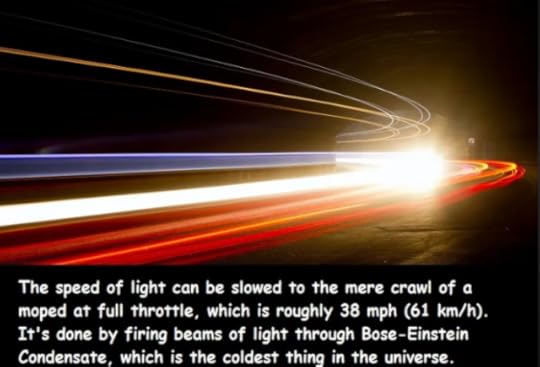
another scheme is to slow down the speed of light so the Solar System becomes 'invisible' to the rest of the universe. This would prohibit space travel forever. (Blech!).
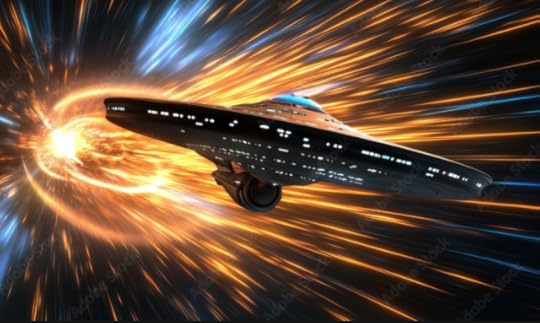
Finally, a third (illegal) proposal involves building spacecraft that can travel at the speed of light, so people can flee to other star systems. (Yay!)
It's impossible to say much about the various story developments without spoilers. I will say that the trilogy extends over many centuries but - because humans can 'hibernate' - the main characters don't die. They 'go to sleep' and 'wake up' (again and again) as needed. This lends a nice continuity to the storyline.
Though I might have done things differently than some characters in the book I enjoyed the story immensely.....until the last part. The end of the book is flat, uninspiring, and scientifically impossible (in my opinion). The finale reminded me of the last episodes of the TV series' "Lost" and "Battlestar Galactica"....fine shows with disappointing conclusions.
The entire trilogy is good but book three is especially ambitious, ingenious, and impressive. Moreover it's probably one of very few science fiction books to contain three original - and fantastic - fairy tales! LOL

Cixin Liu is an excellent writer with a spectacular imagination and a wonderful ability to incorporate scientific concepts into his stories. The time and effort the author must have devoted to researching and writing this trilogy boggles my mind. And the translation from Chinese to English by Ken Liu is skillful and smooth. Good job all around!
I can't recommend this trilogy highly enough to fans of science fiction. Read it. You won't be disappointed.

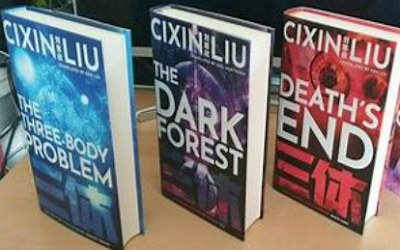
Author Cixin Liu and his 'Remembrance of Earth's Past' trilogy
Rating: 4.5 stars

Ethan Ford - a handyman, kids' baseball coach, and volunteer fireman - is a town hero.

After 13 years of marriage he's still deeply in love with his wife Jorie.....

.....and a good dad to his son Collie.

Then one morning Ethan is arrested for the rape and murder of a young girl fifteen years ago. Jorie and Collie are devastated and the townsfolk can hardly take it in, believing a terrible mistake has occurred.
SPOILER ALERT SPOILER ALERT SPOILER ALERT
To many people's surprise, Ethan pleads guilty to the crime, asserting that he's a 'different man' now. In one way he is, having acquired a new identity.

Collie is distraught and becomes completely withdrawn while Jorie torments herself trying to figure out how Ethan could have done such a thing.

In flashbacks we learn that Ethan was a truly despicable youth who - after he committed the murder - instantaneously transformed himself into a good, caring man.
Other characters in the novel include Jorie's best friend Charlotte, who is suffering from cancer; Jorie's mother and sister who try to support her in this time of crisis; and Kat - an insightful young friend of Collie's. There are also lawyers who advise/defend Ethan, and townspeople who form an 'Ethan support group' to raise money for his defense. This group includes Kat's sister Rosarie, a beautiful but cold 17-year-old heartbreaker who becomes infatuated with Ethan.

The heart of the story involves how Jorie comes to terms with her husband's crime and the actions she decides to take. To me Ethan's sudden transformation into a 'good guy' after the murder is completely unbelievable and the story's finale also rings false. However, the characters are interesting and the book does a good job illustrating the heartbreak and devastation that can occur when a gigantic lie is exposed.
END SPOILER ALERT END SPOILER ALERT END SPOILER ALERT

Rating: 3 stars


