Saturday, May 6, 2017

Review of "The Crossing Places: A Ruth Galloway Mystery" by Elly Griffiths


In this first book in the 'Ruth Galloway' series, the archaeologist helps the police investigate cases
that involve missing children.

*****

When a child's bones are discovered in the saltmarsh at Norfolk, along the coast of England, Detective Chief Inspector Harry Nelson asks Dr. Ruth Galloway - an archaeologist at a local university - to help excavate the remains.


Ruth discovers that the skeleton, which was interred with two Iron Age torques (metal necklaces), is 2,000 years old.


Iron Age Torque

Ruth is thrilled with the find but Nelson is disappointed. He thought the bones might belong to Lucy Downey, a five-year-old child who disappeared a decade ago - a case that's haunted Nelson ever since.


Soon afterwards a four-year-old girl named Scarlet Henderson vanishes, and Nelson suspects she was taken by the same person who abducted Lucy. It turns out the police received a series of taunting letters after Lucy vanished, and similar letters have now arrived about Scarlet.


The letters contain quotes from literature and the Bible, as well as references to local archaeological sites and obscure poetic hints about where the girls are buried.

Nelson asks Ruth to help analyze the letters, and she's soon assisting the police with their inquiries. Against all odds, Nelson and Ruth seem drawn to each other. Ruth is a frumpy, overweight, fortyish academic who lives in an isolated cottage on the saltmarsh with her two cats, Sparky and Flint.


And Nelson is a burly, lifelong cop who resides in King's Lynn with his beautiful, stylish wife and two teenage daughters. Nevertheless, the sparks between Nelson and Ruth threaten to burst into flame.


Nelson realizes that Lucy's abduction 10 years ago occurred shortly after a major archaeological dig in Norfolk. People who worked on the dig include: Ruth; Erik - a renowned archaeologist who was Ruth's mentor in college; Cathbad - a 'druid' who objected to the digging up of an ancient henge; Shona - a gorgeous professor who's Ruth's best friend; and Peter - who was Ruth's boyfriend at the time. Other residents of the saltmarsh are David - who manages the local bird preserve; and Sammy and Ed - a couple with a vacation cottage in the area. Some of these folks are persons of interest to the cops.


As the police investigate the suspects and search for evidence they're assisted by Ruth, who has (almost supernatural) intuitions about the case. The book has some twists, and ends in an exciting, dramatic climax.

I like the story, and Ruth and Nelson are refreshing characters. Nelson is a traditional, hard-working detective (unlike the many fictional sleuths who are troubled alcoholics....LOL). I also enjoyed the bits of the book about archaeological digs, henge circles, causeways, cursuses, Iron Age rituals, and so on....which are quite interesting.


Henge Circle


Wooden Causeway


Excavation of ancient Cursus


Iron Age Death Ritual

The Norfolk location - with its marshes, flats, dunes, beach, sea, and tides - is practically a character in the story, and I could almost sense the salt spray on my face. The geography is integral to the plot since characters are often endangered by swiftly approaching tides and dangerous mud holes. (You wouldn't catch me out on those marshes in the dark!)


Norfolk Marsh

I have some problems with parts of the plot that don't ring true (that is .....are completely unbelievable), but overall this is a good start to the 'Ruth Galloway - Harry Nelson' series. I'll probably read additional books about this dynamic duo.

Rating: 3 stars

Friday, May 5, 2017

Review of "The Three-Body Problem: Remembrance of Earth's Past #1" by Cixin Liu


This is the first book of a trilogy.

The story begins during the early years of China's 'Cultural Revolution.' Ye Wenjie, a young astrophysicist, sees her father - a physics professor - tortured and murdered by a group of young Red Guards.


Like many educated citizens Ye Wenjie is labeled a 'counter-revolutionary' and sent to cut trees for the Construction Corps before being recruited to work at a secret facility called Red Coast Base.

At first Ye Wenjie has limited access to the base's surreptitious activities but in time her abilities and intelligence give her wide access to the installation. Over time Ye Wenjie makes some startling discoveries and engages in some questionable behavior. (To say more would lead to spoiler territory.)


Some years later, when the Cultural Revolution wanes, Ye Wenjie is allowed to return home and become a university professor.


In current times an applied physicist named Wang Miao - who's developed a very strong nanomaterial - is recruited by a committee composed of military officers/police. They ask Wang to help investigate a rash of physicist suicides.


Wang reluctantly agrees and is assisted by a suspended cop called Da Shi - a disheveled, abrasive, pushy, off-putting guy.

>

As things turn out though, Da Shi's ability to think outside the box is useful and his common sense is comforting....so I developed quite a liking for the fellow.

While Wang Miao is looking into the physicist suicides he develops peculiar/frightening 'vision problems' and starts to play an immersive computer game called "Three Body."


The game is set on Trisolaris, a distant planet inhabited by extraterrestrials. Trisolaris has a very unstable environment. During 'chaotic periods' (extremely hot or cold) most Trisolarans are dehydrated, rolled up, and stored in dehydratories. During 'stable periods' (mild weather) the Trisolarans are rehydrated and go about their business. Still, there are frequent 'crashes' when the entire Trisolaran civilization is destroyed and has to start over.


The shifts between chaotic and stable periods on Trisolaris are completely random and abrupt. Thus the player's goal is to discover why they happen and to predict long-term stable periods. Wang determines that the chaos occurs because the planet has three suns....thus the 'three-body problem.' [Note: On the internet the three-body problem is defined as follows: "the problem of taking an initial set of data that specifies the positions, masses and velocities of three bodies for some particular point in time and then determining the motions of the three bodies, in accordance with Newton's laws of motion and universal gravitation."] In essence it's almost impossible to accurately predict the motion of Trisolaris' three suns.....but Wang Miao thinks he can do it.

As the story continues to unfold it turns out that Ye Wenjie's experiences at Red Coast Base, the physicist suicides, Wang Miao's nanomaterial research, and the three-body game are all connected. And they have something to do with the fact that humans have managed to contact an alien civilization. (Again, more information would be a spoiler.)


The story addresses an interesting topic: how would people react if they knew there were other intelligent beings in the universe? And what would happen if the other beings were on their way here? (I've always thought extraterrestrials - if they found out about Earth - might come here, wipe us out, and move in. But maybe that's just me....LOL)

There's a lot of physics jargon in the book and some fancy shenanigans with protons that stretch suspension of disbelief to the max...even for sci-fi.


In the end, though, I enjoyed the book very much. China provides a great (and unusual) background for a science fiction book and the story is riveting, with interesting characters. Highly recommended to fans of science fiction.

I look forward to reading the rest of the trilogy.

The story is being adapted for a series on Netflix.


Rating: 4.5 stars

Wednesday, May 3, 2017

Review of "The Burning Room: A Harry Bosch Mystery" by Michael Connelly


In this 17th book in the 'Harry Bosch' series, the detective and his new partner look into a few old cases. The book can be read as a standalone.

*****


Harry Bosch and his current partner, new murder detective Lucy Soto, work cold cases for the Los Angeles Police Department. Now they have an unusual one. Ten years ago mariachi band member Orlando Merced was shot in what was thought to be a drive by shooting.


Merced survived, but the bullet was too close to his spine to remove, and the shooter was never caught. Now Merced has died from his injuries and the bullet has been recovered. Turns out it came from a rifle, giving Harry and Lucy new lines of investigation.

Meanwhile Harry learns that Lucy survived a long-ago deadly building fire that was thought to be gang-related, and Harry agrees to help her re-investigate that crime.


 Before long the fire is linked to the robbery of a check-cashing store, and Harry and Lucy are working all three cases.


The partners make good use of CCTV, computers, cell phones, and forensics to investigate the crimes, and the suspense builds as they discover one clue after another.


Turns out the investigation into Merced's death has some political implications, and the check-cashing robbery seems to point to an inside job.

Harry and Lucy make an excellent team - their witness interrogations making good use of Lucy's fluency in Spanish. Harry also uses some of his other talents, like opening locked doors with paper clips.....


.....and convincing a couple of old friends - a reporter and an FBI agent - to get him needed information. Harry even gets to spend some quality time with his teenage daughter.


The book has a wide array of interesting characters, including mariachi players, a former mayor and his assistant, a beautiful socialite, a Mother Superior, and more. The story moves at a steady clip to a well-constructed conclusion. This is a good book, recommended for mystery lovers - especially for Harry Bosch fans.


Rating: 4 stars

Tuesday, May 2, 2017

Review of "Crash & Burn: A Tessa Leoni Mystery" by Lisa Gardner


In this 3rd book in the 'Tessa Leoni' series, the private detective helps her cop boyfriend search for a missing child. The book can be read as a standalone.

*****

Following an automobile accident Nicky Frank is injured but able to crawl to the back of the car to attempt to rescue her young daughter Vero. Vero's not in the car, however, and the police search for her in the surrounding woods with the help of a sniffer dog.


The dog can't find the girl's scent and - when Nicky is brought to the hospital - her husband Thomas tells the cops that the couple have no children. Moreover, Nicky - a scotch-loving alcoholic - has recently suffered several head injuries, resulting in amnesia and delusions.


The police wonder if Vero really exists and if Thomas is responsible for his wife's 'accidents.' Police Sergeant Wyatt Foster and his team investigate the case.....


.......with the unofficial help of Foster's girlfriend, private investigator Tessa Leoni.


When Foster and his partner drive Nicky around to re-enact the day of the accident things take a very dramatic turn and her husband Thomas becomes a #1 person of interest.


As the story unfolds a number of unpleasant people and situations are encountered including an alcoholic mother, wife abuse, a creepy brothel, and so on.


To say more would risk spoilers. The book is an intense psychological thriller full of twists and turns but it has some problems. Nicky comes across as not only disturbed but whiny and repetitive - constantly going on and on about finding Vero, and saving Vero, and Vero wanting to fly, and Vero's tea parties, and Vero this and Vero that.


The reader gets it that's she's obsessed with Vero but a little of this goes a long way. In short, better editing may have made for a better story.

The book comes to a sensational and striking climax that satisfactorily explains all the mysteries in the story. All in all a pretty good mystery.


Rating: 3 stars

Monday, May 1, 2017

Review of "Straight Expectations: The Story of a Family in Transition" by Peggy Cryden with Janet E. Goldstein-Ball


Peggy Cryden is a family therapist who specializes in a number of areas, including gender identity and sexual orientation. Peggy's expertise stems, in part, from her own experience raising a transgender son and a gay son. In this memoir Peggy tells her story. 


Peggy Cryden

Peggy's determination to unconditionally support her children may have been fueled by her own difficult upbringing. Both Peggy and her brother were adopted as infants by a middle-class, Jewish couple: Joan and Joe. Joan was a painter and taught English as a second language and Joe was a physicist, immersed in his job as an aerospace engineer. Though Joan functioned well in some areas she was mentally ill and incapable of being a nurturing mother. Peggy didn't know what was wrong with Joan at the time but now believes her mother suffered from borderline personality disorder, bulimia, depressive disorder, and anxiety.

Joan's prescription medicines made it almost impossible for her to rouse herself in the morning to prepare the kids for school, and in the afternoons she was often laid out with headaches and backaches. Joan made little effort to prepare meals: a packed lunch might be a sandwich of peanut butter, mustard, and lettuce.....and her dinners were often burned. Joan also did odd things like eating entire packages of cookies and ice cream bars while pushing her cart through the supermarket and sitting down on the front lawn in her dress and heels. According to Peggy, Joan lacked self-esteem, was insecure about interacting with friends, had panic attacks, and was paranoid - thinking people didn't like her.

For his part Joe was a distant father who had little interaction with his children. Joe's engineering job and his position as a reserve captain in the Navy required a lot of travel, and in his spare time Joe joined 'every club imaginable' and wrote newsletters for all the neighborhood organizations. Thus, Joe didn't spend much time with his children - and when he 'babysat them' expected the kids to be quiet and entertain themselves.

As a result Peggy and her brother had to learn to be self-sufficient, and grew up with few physical or verbal expressions of love from their parents. Living in a home where she felt neglected, Peggy told herself "If I ever have kids, I want my family to be different".....meaning she would bond with her children and be involved in their lives. And in time, this came to pass.

Peggy met her future husband Izzy when she was in her late twenties - after difficult and damaging years as a rebellious teen and 'fast' young adult. By this time Peggy had earned an Associate Degree and was applying to universities, and Izzy was a television advertising executive. Peggy and Izzy got married and had two children: a daughter named Julia (who would later transition to Jake) and a son named Jay.

From the time she was a young child, daughter Julia rejected 'girly' things like dresses and dolls - and preferred to play male characters when she acted out her favorite movies. Conversely, son Jay enjoyed playing with his sister's Barbie dolls and avoided rambunctious boys' games and sports. In time, both children were diagnosed with Attention Deficit Hyperactivity Disorder (ADHD), and Jay had Obsessive Compulsive Disorder (OCD) as well. As Peggy had promised herself, she was a hands-on mother - and she organized therapists and treatment teams for the children.

A few years later, more serious problems arose. At first Julia thought she was a lesbian, but then admitted to her mother that she was transgender.....really a male. In addition, Julia was being severely harassed at high school because she dressed like a boy, and Peggy felt compelled to arrange an independent study program to keep Julia safe. When Julia was fifteen she changed her name to Jake and began hormone replacement therapy (HRT) to align her physical appearance with her true gender. (At this point in the book Peggy starts using male pronouns to refer to Jake.)

Jake's gender affirmation was a long and complex process. When a person transitions from female to male, testosterone supplements can add body hair, lower the voice, and increase musculature. However, gender-affirming surgery is necessary to remove the breasts and - if one chooses - restructure the genitals (though Peggy suggests this is rare for transgender men). Peggy was concerned about her son's transition but ultimately accepted his gender dysphoria.....and this probably helped Jake through difficult times. After Jake's transition he realized he was attracted to men - so Jake is a gay transgender male.


Jake

Meanwhile - because the family had been focused on Jake - Jay's difficulties were being overlooked. In his early teens Jay developed an eating disorder and starting showing signs of anxiety and depression. By the time Jay was sixteen he was often dizzy, irritable and fatigued. A trip to the doctor revealed that Jay's weight had dropped from 153 to 103 pounds. He also had low blood pressure and decreased heart rate, which caused him to pass out, get migraines, and have heart palpitations. Jay was diagnosed with anorexia nervosa - and once again Peggy put together a treatment team.

Shortly afterwards, Jay was 'caught' dating a boy, and confessed that he was gay. Jay admitted to his parents: "I didn't want to tell you because......I know how much you went through with Jake. I wanted you to think at least one of your kids was 'normal'." Peggy assured her son that she loved him 'no matter what' and Jay was honest about his boyfriends from then on.

All these changes in the family required a lot of adjustment. Peggy admits "We went from being the parents of a caring older sister and adoring younger brother to being the parents of two gay sons, and this was a whole different dynamic that affected everyone in the family." Peggy's husband Izzy took a while to come to terms with Jake's transition. In addition, Jay's perception that his brother was getting all the attention created a distance between the boys, who were once best friends. These and other issues required time and effort to be resolved, but the entire family is very close now. Both boys have graduated college, live on their own, and are doing well - so this is a success story all around.

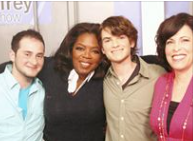
In an effort to help other people like Jake and Jay, Peggy allowed the family's story to be publicized. Jake participated in an MSNBC documentary entitled "Born in the Wrong Body", and Peggy and both boys made appearances on the 'Oprah Winfrey Show.'


Peggy, Jake (far left), and Jay on the 'Oprah Winfrey Show'

Afterwards Peggy and Jake became advocates for transgender individuals, held workshops, and started a foundation called Trans United with Family and Friends (T.U.F.F.), which raises money to help transgender people.


Towards the end of the book Peggy discusses therapeutic methods she uses with LGBTQ individuals. She also provides suggestions for further reading and includes a list of resources for the LGBTQ community.

I found the book engaging and came to admire Peggy's strength and understanding in the face of family turmoil. To some extent, though, I feel the book's title is misleading. I expected the story to be almost entirely about Jake and Jay, but at least half the book is about Peggy herself: her childhood; her turbulent teen years; her 'substitute' mothers; her relationship with Izzy; her adjustment to Izzy's 'buttinksy' family; her education; her career; her pregnancies; her deliveries; her early years as a mother; and so on. Though all this is interesting, I would have liked to learn more about the boys and how they feel about their experiences. But maybe that's a different book.

Peggy is very hard on her parents in this book, especially her mom, whose poor mothering is mentioned again and again - to the point where it's repetitious. As a therapist, Peggy might be expected to understand her mother's psychological problems.....but maybe Peggy's childhood hurts are too deep to let go.

I'd recommend this memoir to people interested in LGBTQ concerns, especially readers who want to know more about being transgender. The book also provides a compelling story of an admirable and devoted mother and - on that score - would probably appeal to a general readership.

Thanks to Netgalley, the authors (Peggy Cryden with Janet E. Goldstein-Ball ), and the publisher (Jessica Kingsley Publishers) for a copy of the book.


Rating: 3 stars