
Janelle Thompson was a high school senior in Webster Groves, Missouri when she was arrested for shooting her parents, State Senator Ted Thompson and May Thompson. Ted and May were strong advocates of the Second Amendment and the Castle Doctrine, and Janelle had been taught to shoot as a child and frequently practiced at a gun range.
The story is narrated by Janelle, who toggles back and forth between the present, when she's being tried for murder, and eleven months ago, when her parents were killed. For simplicity, my review will be chronological.
Eleven months ago, Janelle was doing well. African-American Janelle was adopted by a White couple, Ted and May Thompson, when she was three years old. Janelle grew up in upscale Webster Groves, Missouri, did well in school, had a best friend named Mona, and planned to attend the University of Missouri - St. Louis.
The only fly in the ointment was Janelle's boyfriend Liam Campbell. Liam had been a college football star until he was injured and quit school. Liam then moved back to Webster Groves and took a job delivering pizza. Liam's lack of ambition didn't sit right with Janelle's parents, who forbid the romance. However, Janelle thought "I'm eighteen and I'll do what I want", and she continued to see Liam on the sly.
That's when Janelle's troubles started. On a Thursday night eleven months ago, Janelle told her folks she was staying with her friend Mona, but she was really spending the night with Liam. When Janelle got home on Friday, her parents weren't around, and she couldn't reach them. Janelle was puzzled, but saw information about a weekend political event on her dad's computer, and thought her parents were out of town for a few days.
Janelle proceeded to do her regular housecleaning chores, and - like a typical teenager - decided to have a party. The fun got WAY out of control with drinking, drugs, vomiting, loud music, and complaints by the neighbors. The police showed up and shut the party down.
The house was a complete mess, so Janelle cleaned up again, then lazed around until she learned her folks hadn't shown up at the political event. Finally, Janelle called 911 to report her parents missing.
Detectives Kate Perkins and Brian O'Rourke treated Janelle as a suspect from the get-go, because she'd cleaned up and had guns in her room. And Janelle (who apparently hadn't watched enough television) didn't immediately ask for an attorney. I don't want to give away too much, but Janelle was arrested for murder.
Skip ahead eleven months and Janelle is in jail and on trial. Janelle describes lockup and her jail mates, all young women accused of serious crimes. The girls eat together, talk about their trials, buy things from the commissary, get visitors, and so on.
Janelle also describes the trial scenes, many of which don't ring true. I'm surprised at this because the book's co-author, Nancy Allen, is a former Missouri prosecutor.
For example, here are scenarios that stretch credulity:
Janelle's public defender, Becca Kelly, seems very inexperienced for a murder trial. One of the prosecution witnesses is a complete shock to Becca, as if she didn't look at the witness list.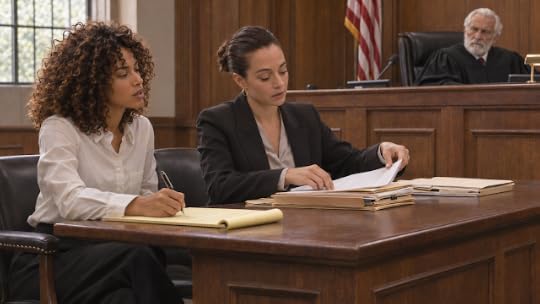
During the trial, Janelle is ordered to wear leg restraints and a shock cuff (like a remote controlled taser). When Deputy Gaines accidentally shocks Janelle, who rolls on the floor screeching in pain, there are no consequences. Deputy Gaines just says, 'Oops, that was an accident.' And the shock cuff stays on!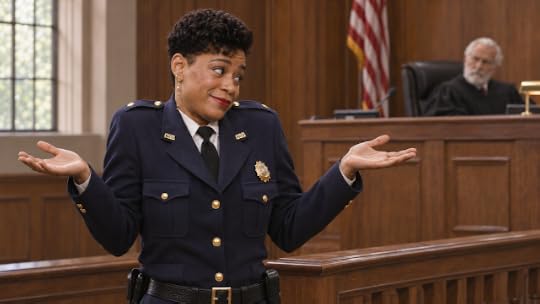
Judge Ronald Harter is clearly biased, and always rules against the defense. Harter would probably be sanctioned on appeal.
In any case, the trial rolls along and we eventually learn the truth. The novel is engaging and suspenseful, and would probably appeal to YA readers.
I listened to the audiobook, narrated by Marsai Martin, who does a fine job.
Thanks to Netgalley, James Patterson, Nancy Allen, and HachetteAudio for an ARC of the book.
Rating: 3 stars

No comments:
Post a Comment