
'The Zombie War' began 20 years ago, and 'victory' was declared 10 years ago, after most zombies had been destroyed. Some undead still pop up here and there, frequently in bodies of water, but human survivors are trying to rebuild their lives in confined communitie
To document the zombie pandemic, author Max Brooks - an agent of the United Nations Postwar Commission - traveled around the world interviewing survivors on every continent- as well as survivors on dirigibles and ocean-going ships. Brooks then put survivors' stories together for this book, to provide a historical record of the zombie crisis.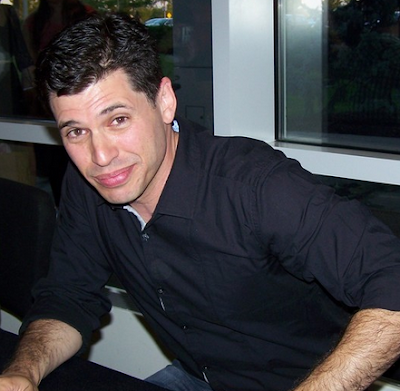
Brooks spoke to civilians, military personnel, doctors, politicians, astronauts, mental patients, movie makers, men, women, children, etc. to get 'the big picture', and he heard tales of battles, fortifications, fear, bravery, hardship, weaponry, tanks, safety gear, sniffer dogs, cold zones (with frozen zombies), exploitation, cowardice, disease, self-interest, PTSD, the continuing danger, suicides, and on and on.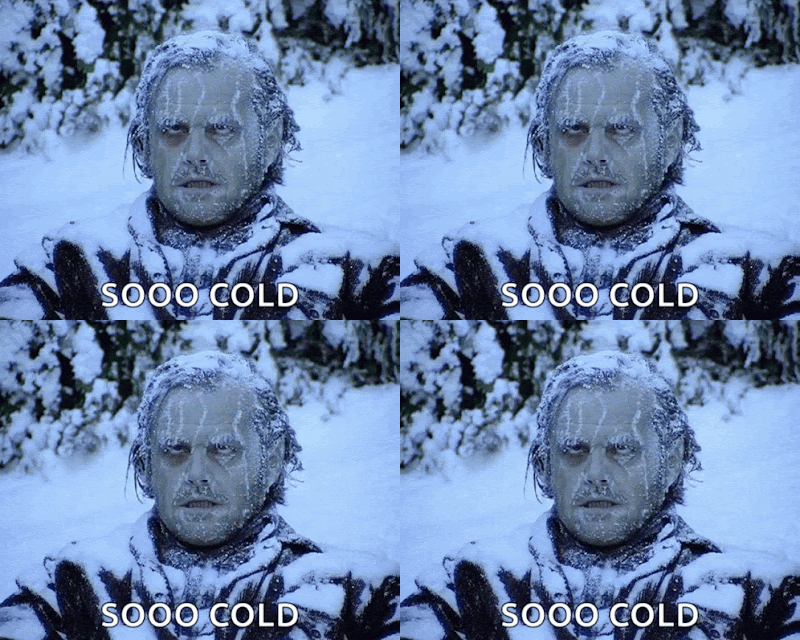
Zombies are inactive in frigid weather
I'll give a brief overview of Brooks' narrative, to provide a feel for the story.
*****
'Patient Zero' seems to have been a 12-year-old boy in the Chinese village of New Dachang, near the Three Gorges Reservoir. The child had been bitten while salvage diving, and he infected a handful of other villagers.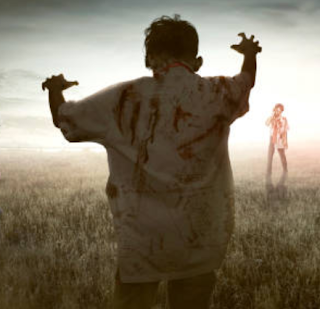
When Dr. Kwang Jingshu called the Ministry of Health, fifty agents from the Ministry of State Security - wearing hazmat suits - arrived in helicopters and took away the 'patients'.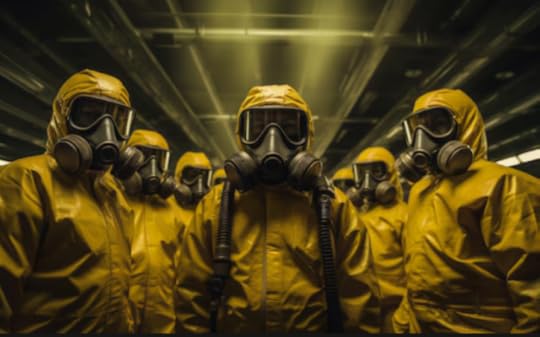
China hush-hushed the incident, and the outbreak soon spread far beyond China's borders by way of smugglers; fleeing refugees; organ donations; etc. In the early days of the pandemic, most people didn't know what was happening.
The zombies' appearance in Cape Town, South Africa is described by Jacob Nyathi: 'People were running down the street shouting "Run! Get out of there! They're coming!"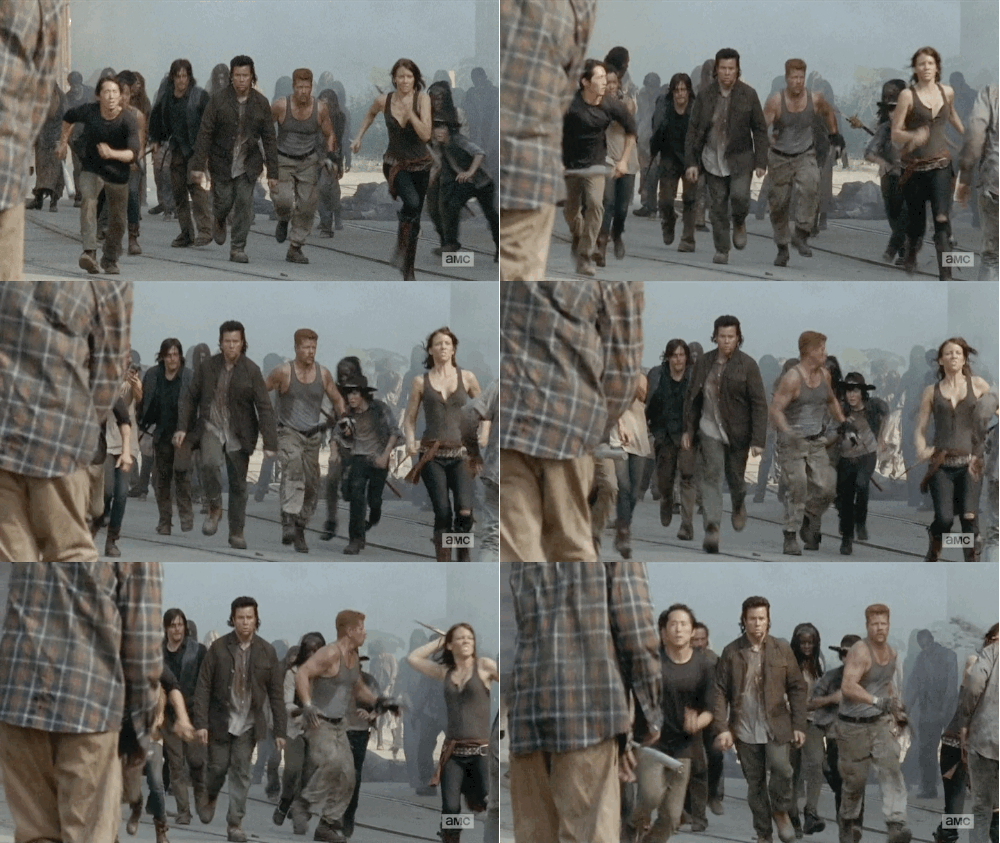
Nyathi recalls, 'Something grabbed me from behind. I spun, ducked and kicked hard. Black fluid ran down the front of his white shirt. A knife protruded from his chest. He growled. He lunged. My hand came up against a heavy cooking pot. I hit him again, and again, bashing his skull until the bone split open and the brains spilled out across my feet.'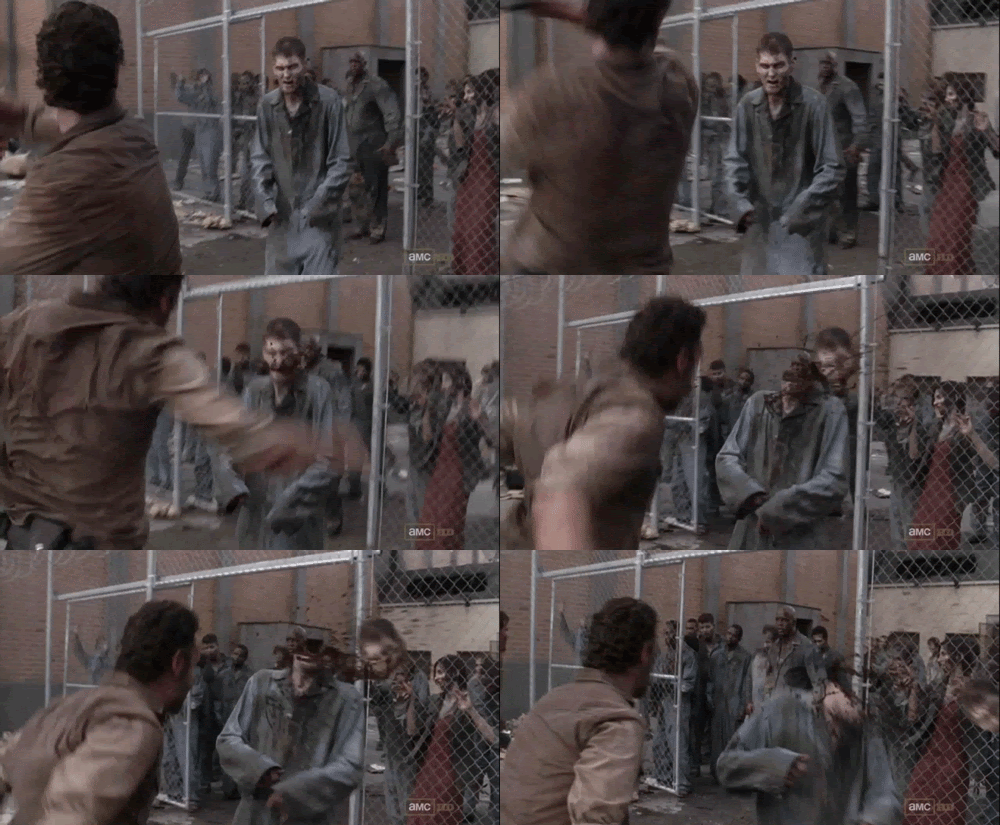
Since South Africa had the first publicly acknowledged outbreak, the 'illness' was called 'African rabies'. This misnomer slowed understanding of the looming crisis, with terrible consequences.
The only country to comprehend 'the plague' early on was Israel, whose experts realized the dead were reanimating (becoming zombies). The Israelis published the 'Warmbrunn-Knight' report to warn the world, but the treatise was largely unread or ignored by every government organization in the world. Thus the 'African rabies' notion was accepted for WAY too long, and the plague reached epidemic proportions.

Towards the beginning of the pandemic, General Travis D'Ambrosia and other United States military commanders - though not accepting the notion of zombies - knew something was very wrong. The commanders proposed a plan to the White House that involved 'not only eliminating the threat within the United States, but rolling it back and containing it throughout entire world.' Ultimately, the program, 'which required Herculean amounts of both national treasure and national support', lacked approval, and fell apart.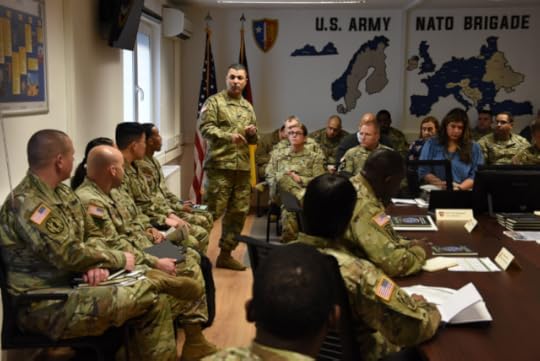
Some venal corrupt people, like Breckinridge Scott, took advantage of the crisis. Scott admits, "When I first heard about the outbreaks, back when it was still called 'African rabies', I saw the opportunity of a lifetime."

Scott and his collaborators marketed a 'rabies vaccine' called Phalanx, which did nothing to stop the plague, but made Scott and his compatriots very wealthy.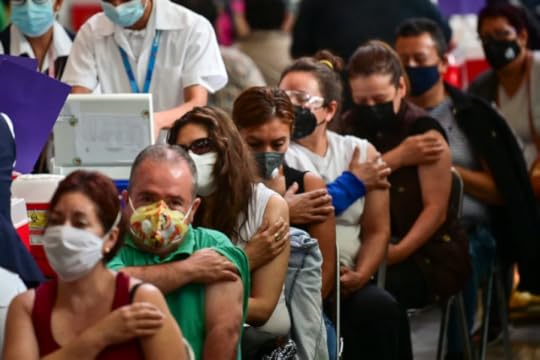
People tried to flee from zombies in every imaginable conveyance: boats, ships, submarines, planes, cars, etc., and Max Brooks hears many tales of desperate flights. Gavin Blaire, of America's Civil Air Patrol, describes evacuees on the road. 'The line stretched to the horizon: sedans, trucks, buses, RVs, tractors, a cement mixer, a flatbed, anything that could drive....People were riding on top of everything, on roofs, in between luggage racks. I saw people lying by the side of the road, barely moving or not at all. A few miles later I saw why. Those creatures were swarming among the cars. I saw those things reach in open windows, pulling people out or pulling themselves in.'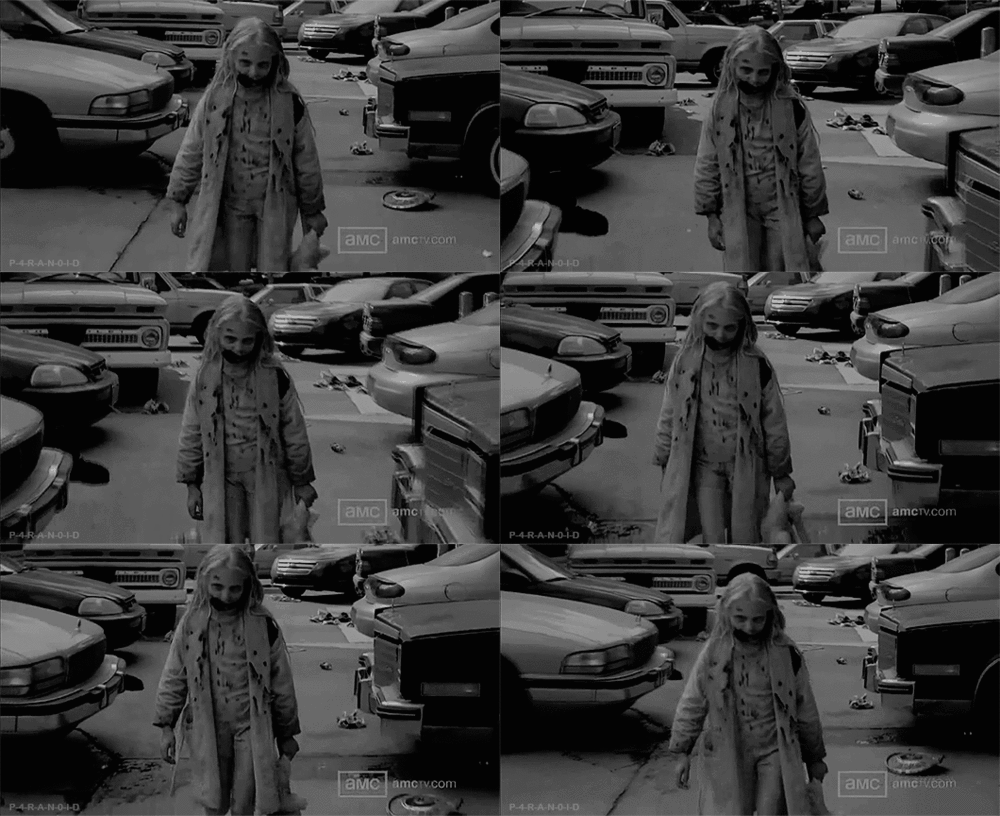
During the chaos, nuclear weapons were deployed by Iran and Pakistan. Former Major Ahmed Farahnakian of the Iranian Air Force explains what happened: 'The problem was refugees, millions of them. We demanded the Pakistanis get control of their people. They assured us they were doing all they could. We knew they were lying. Every day hundreds of thousands of people crossed our border, and tens of thousands were infected. We had to protect ourselves.'

Thus, nuclear bombs were exploded, leading to more death when the radiation clouds spread over India, Southeast Asia, the Pacific, and America.
Many world leaders seemed completely helpless in the early days of the Zombie War, leading to 'The Great Panic'. Former U.S. Army Infantryman Todd Wainio describes the atmosphere as completely chaotic.

'You remember what it was like, people just freaking out.....boarding up their houses, stealing food, guns, shooting everything that moved. They probably killed more people, the Rambos and the runaway fires, and the traffic accidents and the whole shit storm.....I think that killed more people at first than zombies.'

To reassure the American public, the United States military decided to make a stand at Yonkers, a suburb just north of New York City.

Wainio notes, 'I guess I can see why the powers that be thought that one big stand-up battle was such a good idea....because they needed a propaganda smackdown.'
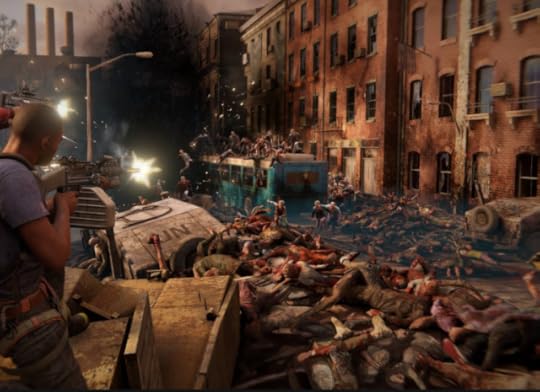
The battle of Yonkers was a disaster from start to finish. Wainio recalls, 'After planes released ordnance on the undead, the ground shook, the sky went dark, debris was everywhere - earth and ash and burning whatever above my head. I felt this weight slam between my shoulder blades, it was a head and torso, all charred black and still smoking and trying to bite.....and then the zombies came, right out of the smoke like a freakin' little kid's nightmare! Some were steaming, some were even still burning, some were walking, some crawling, some just dragging themselves on their torn bellies....and that was when the line of soldiers collapsed.'

Ironically, South Africa developed a plan that turned the tide for humanity against the undead. Afrikaner Paul Redeker believed that 'to try to protect/save everyone would stretch the government's resources to the breaking point'.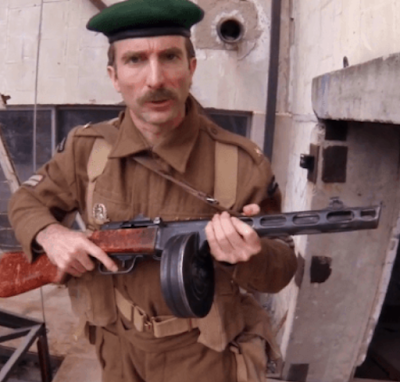
Thus the 'Redeker Plan' proposed the following:
◆ South African military forces would withdraw to a 'safe zone' protected by some natural obstacle like mountains or rivers.
◆ The army would eradicate the zombies within its borders and defend the area against further onslaughts.
◆ A fraction of the civilian population would be evacuated to the safe zone, to provide a labor pool and to demonstrate the government was on the job.
◆ Those residents left behind would be herded into special isolated zones to be 'human bait'; they would attract the zombies and prevent them from following the army and 'chosen people' to the safe zone.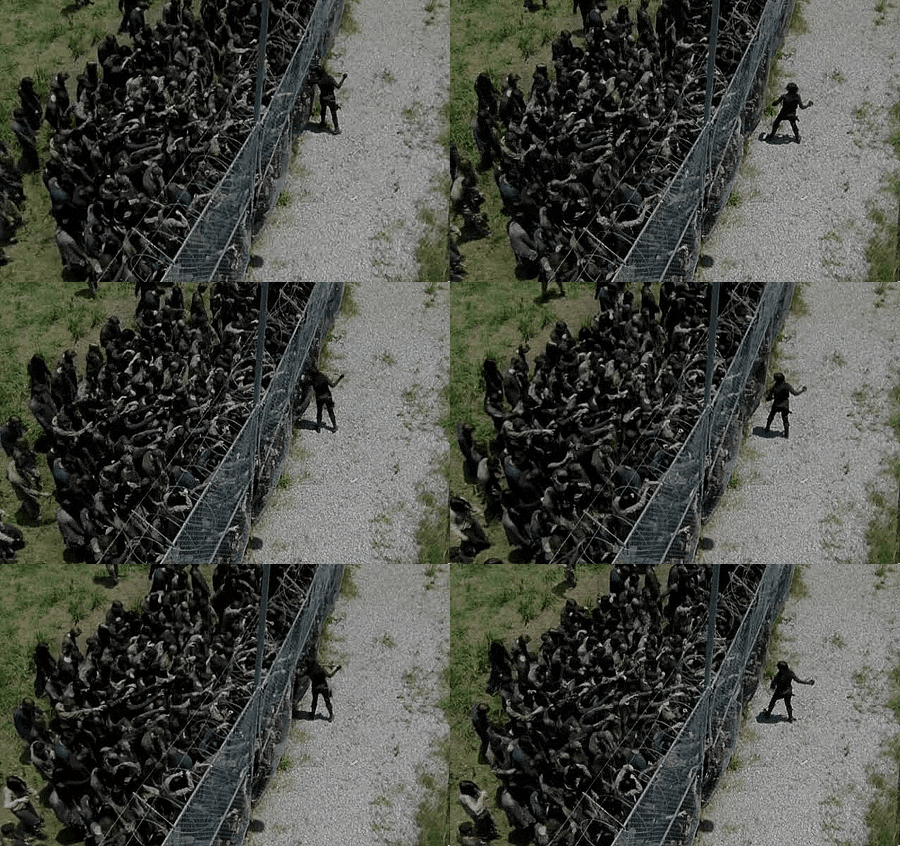
As things turned out, the 'Redeker Plan' was used by South Africa and (secretly) adopted by other countries as well.
Mystery still surrounds North Korea, as explained by Deputy Director of the South Korean Central Intelligence Agency, Hyungchol Choi.

The deputy director acknowledges that no country was better prepared to repel the zombies than North Korea, which had rivers, mountains, heavily fortified borders, an extensive subterranean system, and a heavily militarized population. But ALL the people of North Korea seem to have disappeared. Director Choi says he's pushing for an expedition to the North, but is blocked by speculation like, 'What if you open the door to some underground city and 23 million zombies come spewing out'? So the puzzle continues.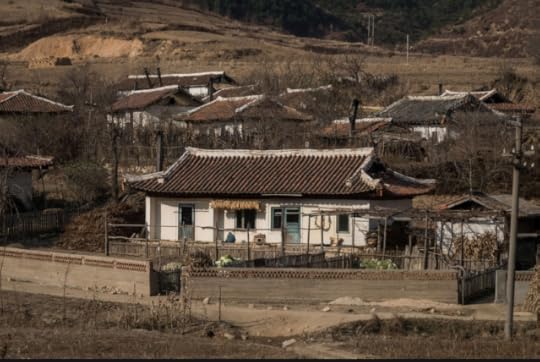
Once 'safe zones' had been established around the world, a large-scale plan to defeat the zombies was discussed at a conference aboard the decommissioned aircraft carrier USS Saratoga. Merchant ship's master Ernesto Olguin recalls, 'The American ambassador rose and said it was time to go on the attack, to get out from behind our established defenses and begin retaking infested territory.'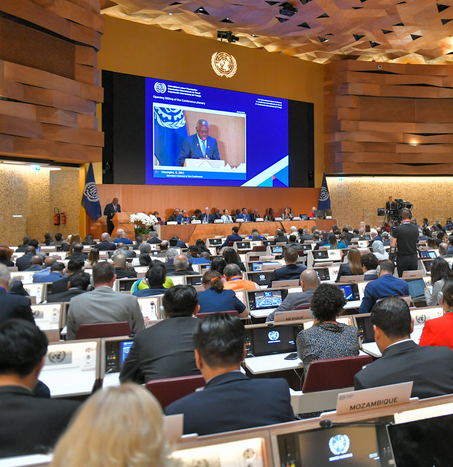
Others argued, 'Why in hell should we risk even more lives, suffer more casualties when all we had to do was remain safe while our enemy simply rotted away?'

The first side countered that 'not all the living dead were rotting away. Couldn't just one restart the plague all over again?' And on and on.
Finally, the choice was made: attack!

Nevertheless, the skeptics had a good point, because zombies still exist NOW, 10 years after victory was declared. Many of the undead are in the oceans, where they're still being hunted by naval forces.
Master Chief Petty Officer Michael Choi aboard the USS Holo Kai - a diver in the U.S. Navy's Deep Submergence Combat Corps - explains, 'My war never ended. They say there are still somewhere between 20 and 30 million undead, still washing up on beaches, or getting snagged in fisherman's nets. You can't work an offshore oil rig or repair a transatlantic cable without running into a swarm.'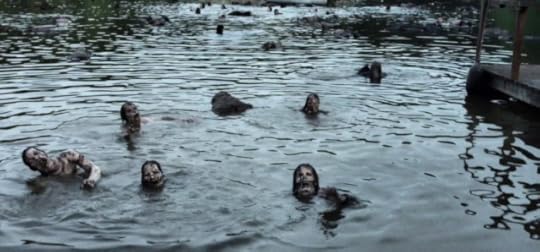
Choi speculates, 'How are these zombies still around? Nothing in the world corrodes like saltwater. Is it the temperature at these depths, is it the pressure? I'm sure someone real high up has all the answers.' Choi demonstrates his atmospheric diving suit, kind of like a space suit and a suit of armor rolled into one, that he uses for hunting zombies in the ocean....which seems to be a never-ending battle.

Dr. Kwang Jingshu, who first reported 'Patient Zero' in China, is still treating patients twenty years later.

After diagnosing a child with a chest cold, Kwang tells Max Brooks, 'It's comforting to see children again, I mean those who were born after the war, real children who know nothing but a world that includes the living dead. They know not to play near water, not to go out alone or after dark in the spring or summer. Children don't know to be afraid, and that is the greatest gift, the only gift we can leave them.'
Max Brooks provides MANY more interviews than I've highlighted here, and depicts an extensive picture of the zombie horror. This is an evocative, realistic, frightening portrayal of the zombie apocalypse. It's clear that IF zombies appeared amongst us, they'd be here for good.....like cockroaches. And it's scary to think that, even if humanity defeats the undead, one lone zombie could start the pandemic all over again.
In addition to telling a good story, Brooks takes the opportunity to highlight factors that exacerbate crises, like government incompetence, corporate corruption, 'doubting thomases' who refuse to see what's happening around them, and folks who refuse to take measures early on.
I watched the 2013 movie 'World War Z' which - though inspired by this book - tells a completely different story. It's still a good film though.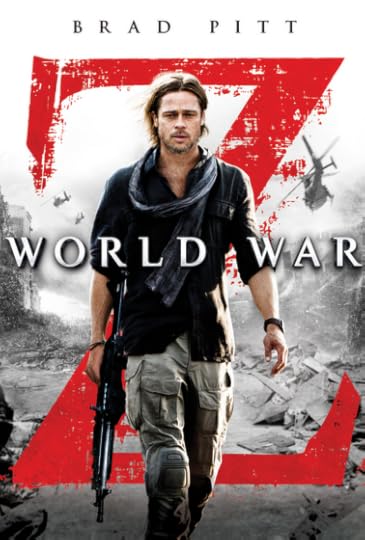
I'd highly recommend the book and movie to fans of zombie fiction.
Rating: 4 stars

No comments:
Post a Comment