
Author Greg Melville is a decorated Navy veteran, adventure writer, and award-winning teacher at the United States Naval Academy. During college, Melville's summer job mowing cemeteries in his hometown of Bedford, Massachusetts ignited a fascination with graveyards. Greg writes, "The town's past came alive...I learned who died rich and who died poor...who lived full lives and whose lives were cut short...I became familiar with the long-forgotten names of war heroes...every gravestone seemed like a mystery waiting to be solved."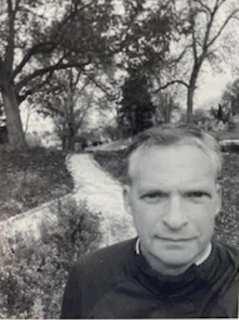
Author Greg Melville
Cemeteries are the time capsules of our communities, and for this book Melville researched and visited graveyards across the country, often during family vacations. Here, Melville relates the story of burial grounds as archives of art, history, literature, religion, commemoration, discrimination, life, death, and more. Melville also uses cemeteries as hubs to discuss historical and cultural influences from around the world, so the book is full of interesting information.
To get things rolling, Melville mentions an array of historic burial customs, including a prehistoric cave interment in Wales; an ocher-covered Clovis (hunter-gatherer) baby in America; pyramids in Egypt; tombs in Greece; feng shui interments in China; cremations in the Roman Empire; and funeral traditions around the world, associated with different religious practices.
For brevity, I'll just include highlights of some American resting places.
✿ Historic Jamestowne, Virginia (established 1607)
Jamestowne (or Jamestown) is the site of England's first permanent North American settlement. When the original colonists landed there, Jamestowne was mosquito-infested and marshy, and deaths from disease, starvation and weather were rampant.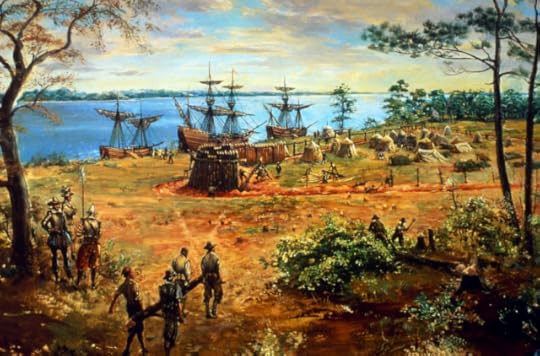
Depiction of Jamestowne
The residents buried the deceased in unmarked mass graves, both to save time, and to obscure the number of fatalities from enemies like the Algonquian peoples. An exception was made for the Jamestowne leaders, who were interred with more respect.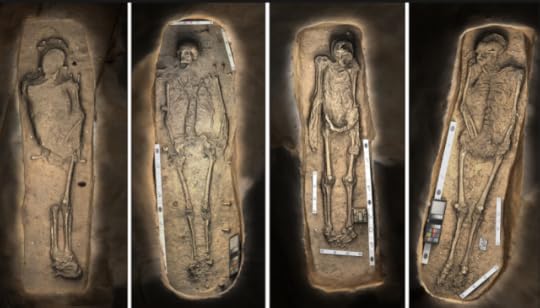
Archaeologists excavated graves of Jamestowne leaders
Not all the deceased got buried though. The worst drought in centuries turned meager gardens to dust, and Jamestowne's famine-stricken people ate their horses, cats, dogs, rats, mice...and then their own dead.
✿ Burial Hill: Plymouth, Massachusetts (Established 1622)
Burial Hill contains some of the Mayflower's original passengers, who landed in 1620. Plymouth was an inhospitable place, and weather, malnutrition and disease killed half the Mayflower migrants within months of landing. What saved the rest was grave robbery. The local Wampanoag people buried their dead with stores of corn, wheat, and beans, and the Pilgrims dug up the graves and took the food.
The burials of deceased colonists took place at night, to hide the decimation from the Wampanoag, and Pilgrims later planted crops over the graves, to disguise the burial grounds. When the Pilgrims became more firmly established they built a stone fort/church on a steep hill, and designated the Burial Hill 'cemetery' beside it. Gravestones didn't appear until the late 1600s, and interments continued until 1950.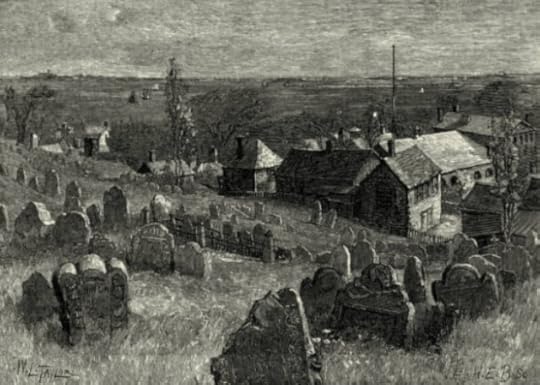
Depiction of Burial Hill
Relations between the Pilgrims and the Wampanoag were not overtly hostile at first, but when fighting broke out the Indians lost their lives and land, and over time, most of their burial grounds were looted and destroyed. Eventually, the terrible treatment of Indians raised public concern, and in 1990 Congress passed the Native American Graves and Repatriation Act, which allowed tribes to reclaim items (including human remains) from museums and federal agencies.
✿ Colonial Jewish Burial Ground: Newport, Rhode Island (Established 1677)
This small cemetery, with an Egyptian-style granite entryway, is the oldest Jewish holy space still standing in the United States. It was established during a time of repressive prohibitions against the practice of Judaism in both Europe and the North American colonies, and its creation directly influenced the First Amendment to the U.S. Constitution, protecting the right to worship without government restraint.
Sadly, symbols of religious liberty like this are targets for intolerance.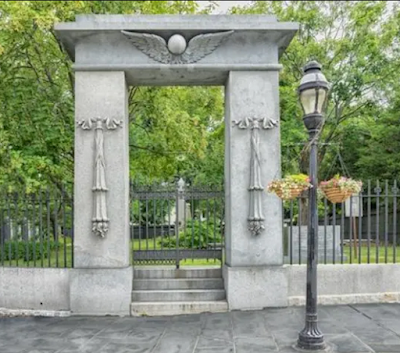
Entrance to the Colonial Jewish Burial Ground
✿ Monticello African American Graveyard: Charlottesville, Virginia (Established Late 1700s)
Monticello, the Thomas Jefferson estate, contains the Monticello Graveyard, where Jefferson lies with relatives, descendants, and a few friends. Monticello's mansion was built and maintained by slaves; enslaved people cultivated Monticello's crops; and Jefferson had children with his slave Sally Hemmings. However no Black people are interred in the Monticello Graveyard.
Monticello's lone identified African American burial ground was discovered in 2001, and it's unknown how many more slave burial grounds lie on the estate, or where they might be. Melville observes, "Southern plantation owners like Jefferson took active measures to keep African American graveyards and funeral practices on their properties out of general sight, and mind. The locations of these spots were almost never put into any written record. This is why we only know the locations of a tiny fraction."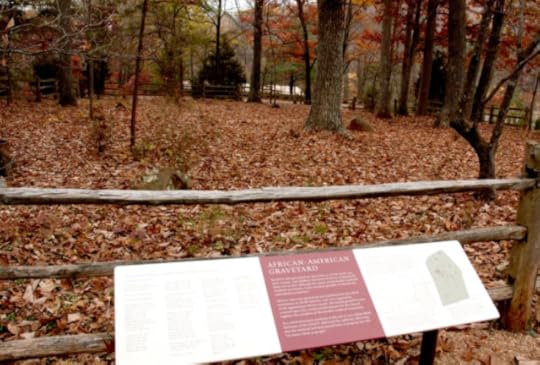
Monticello African American Graveyard
✿ Mount Auburn Cemetery: Cambridge, Massachusetts (Established 1831)
Mount Auburn Cemetery has fern-carpeted groves of ancient oaks and maples; lily-filled ponds; shrubs, roses, azaleas, and zinnias; turtles, lizards, and coyotes - along with population of roughly 100,000 deceased people. This and other rural-style cemeteries, inspired by Père Lachaise Cemetery in Paris, turned burial grounds into tourist destinations.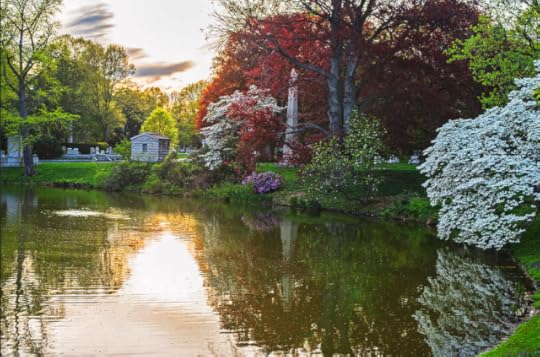
Mount Auburn Cemetery
✿ Green-Wood Cemetery: Brooklyn, New York (Established 1838)
Almost from the start, Green-Wood Cemetery attracted New York's finest sculptors and architects; it inspired writers and poets; it lured painters looking for a muse; it was the city's first major public art museum; and it brought "a constant influx of sublime new art to the masses like never before in America." Many people believe Walt Whitman's poems, 'Leaves of Grass', is a tribute to Green-Wood. Among the 600,000 people buried in Green-Wood are countless artists, authors, musicians and other notables.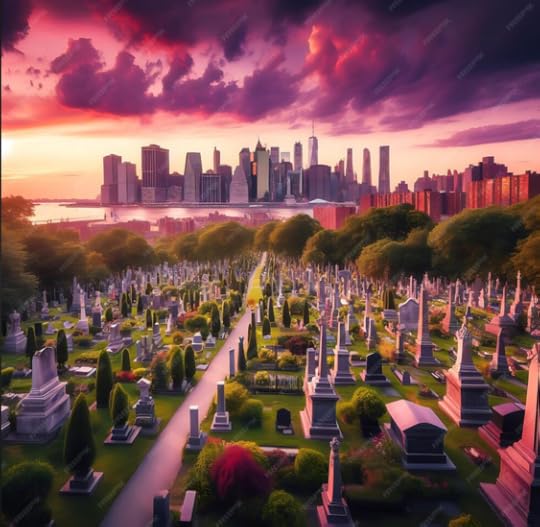
Green-Wood Cemetery in Brooklyn has a view of the Manhattan Skyline
✿ Laurel Grove Cemetery: Savannah, Georgia (Established 1853)
The Laurel Grove Cemetery was modeled on Green-Wood, but it's split into two sections: North and South. Laurel Grove North, the traditionally white section, has wide oak-shaded avenues with Gothic statues and flamboyant grave markers. Laurel Grove South, the traditionally Black section, has narrow paths, fewer trees, and browned patches of grass. Melville notes, "In the southern United States...racial segregation of the dead is still very much alive."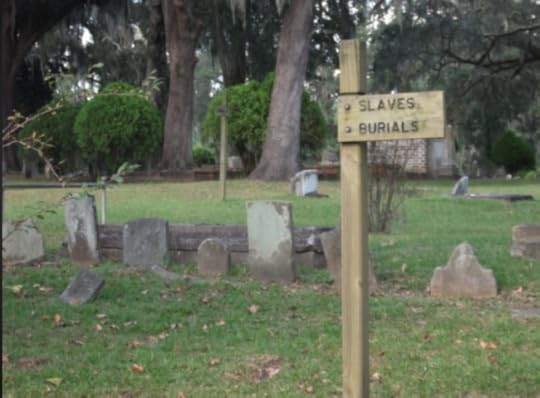
Laurel Grove Cemetery South has a section where slaves are buried
✿ Gettysburg National Cemetery: Gettysburg, Pennsylvania (Established 1863)
The Civil War's tremendous death toll, about 620,000, brought with it the problem of burials. Most of the dead were laid in anonymous mass ditches on battlefields or in local churchyards. Many people believed this denied salvation to their loved ones, who couldn't be properly bathed, groomed, and mourned at home.
Abraham Lincoln's Gettysburg Address, at the Gettysburg National Cemetery, diminished these worries by insuring a 'good death' could happen on the battlefield, in the name of justice. Americans came to regard national cemeteries as holy grounds that insure salvation, and - to allow families to bring home loved ones for a good burial - the embalming industry mushroomed. (An example of unintended consequences.)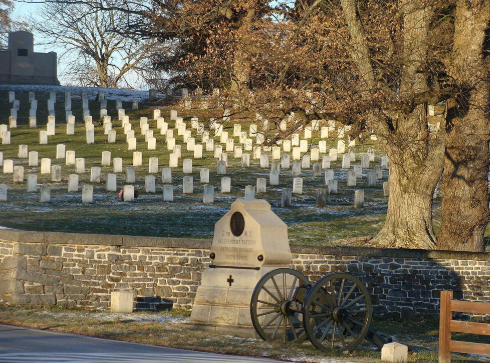
Gettysburg National Cemetery
✿ Boothill Graveyard: Tombstone, Arizona (Established 1878)
Old cemeteries like Boothill Graveyard are common in the remains of frontier settlements, from Dodge City, Kansas to Deadwood, South Dakota. These burial grounds - which contain the bodies of sheriffs' deputies, bandits, bank tellers, and saloonkeepers - lend authenticity to a locale's touristy Old West heritage.
What's missing from these graveyards are the bodies of the thousands of Chinese immigrants who worked in the gold and silver mines and built the transcontinental railroad. Boothill Cemetery's two westernmost rows, known as the Chinese section, have seven marked graves belonging to people of Chinese descent, and a few unmarked graves. A group of organizations known as the Six Companies, that facilitated Chinese immigration to America, also shipped the bodies of Chinese immigrants back to their homeland for a traditional burial.
This was just as well, because cities like Los Angeles and San Francisco banned Chinese people from local cemeteries, and forced them to pay for interment in potter's fields - where the white poor, homeless, and criminals were buried for free.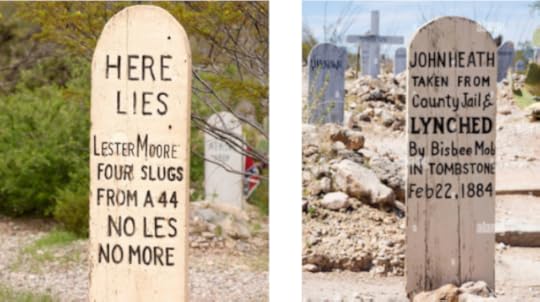
Grave Markers in Boothill Graveyard
✿ Nature's Sanctuary, West Laurel Hill Cemetery: Philadelphia, Pennsylvania (Established 2008)
"Nature's Sanctuary, where graves are dug by hand and bodies are buried in simple shrouds or biodegradable caskets - eliminates nearly all the expensive, eco-hostile burial must-haves placed upon people by the Death Industrial Complex."
The 'green' burial ground dispenses with caskets, vaults, embalmment, and gravestones. It also helps the environment. Each year, burials in America deposit 4.3 million gallons of toxic embalming fluids into the ground; inter 20 million board feet of wood; 1.6 million tons of concrete; and 81,000 tons of metal. There are also chemical fertilizers, herbicides, and pesticides used to keep cemetery grounds looking good, along with regular mowing with fuel-guzzling machines.
On the downside, natural cemeteries violate the American ideal of leaving a mark -having a little plot of earth to call our own, and a gravestone noting, 'I was here.'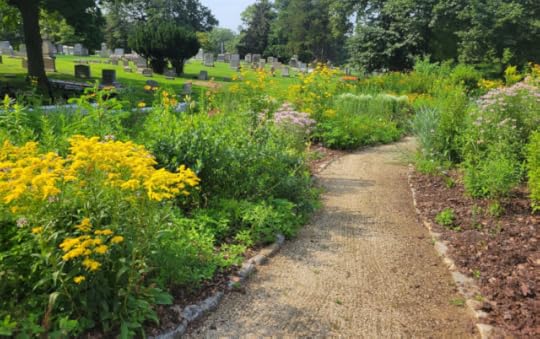
Nature's Sanctuary section in West Laurel Hill Cemetery
Other cemeteries highlighted in the book are:
✿ Sleepy Hollow Cemetery in Concord, Massachusetts - the country's first conservation project.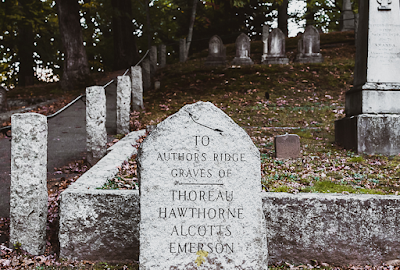
Famous graves at Sleepy Hollow Cemetery
✿ Arlington National Cemetery, Arlington, Virginia - the cemetery, built on Robert E. Lee's hilltop home, led Americans to value the honor of dying for one's country and led to increased enlistments.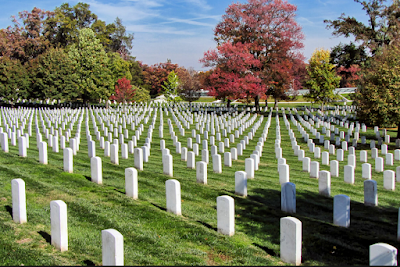
Arlington Cemetery
✿ Woodlawn Cemetery, Bronx, New York - the cemetery's layout was the example for planned communities like Levittown, New York.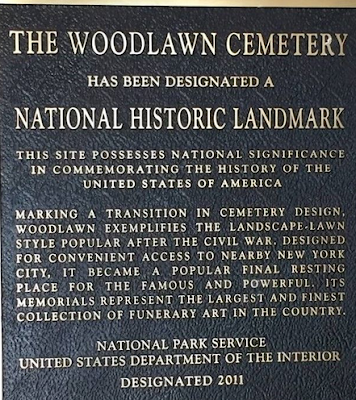
Plaque at Woodlawn Cemetery
✿ Chapel of the Chimes: Oakland, California - this large indoor cemetery has rows and stacks of 30,000+ urns filled with cremated remains, along with a few full-body tombs.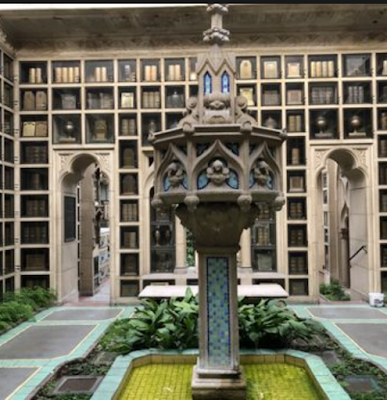
A columbarium at Chapel of the Chimes
✿ Hollywood Forever Cemetery: Los Angeles, California - to compete with other cemeteries and the metaverse, Hollywood Forever has gorgeous grounds, residents from Tinseltown, and activities such as concerts, movie screenings, author events, and cultural celebrations - the most popular being Día de los Muertos.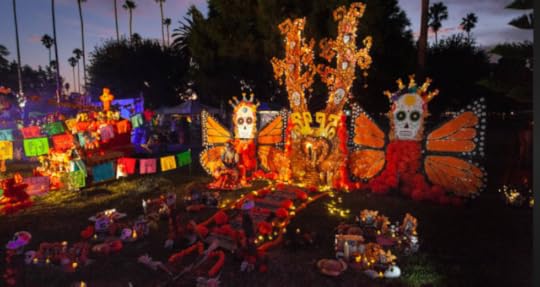
Día de los Muertos at Hollywood Forever Cemetery

Bust of Burt Reynolds in Hollywood Forever Cemetery
✿ Forest Lawn Memorial-Park: Glendale, California - this beautiful cemetery, which houses many Hollywood celebrities, was founded by Hubert Eaton, who found ways to make a fortune from the non-profit burial ground.
✿ Central Park in Manhattan, New York - the most popular repository for human cremains.
An important issue mentioned by Melville is the fact that cemeteries are running out of space. One possible solution is cremation - in Japan, 99.8% of people are cremated. Another solution might be 'online cemeteries.' Melville notes that "the need for cemeteries as permanent reminders of our existence is becoming obsolete in the face of the Digital Immortality metaverse, where we can be memorialized with infinitely more data than what can be carved into a piece of granite."
Using cemeteries to chronicle important aspects of American history is clever and entertaining. I enjoyed the book and highly recommend it.

No comments:
Post a Comment