

Author Tim Queeney
Author Tim Queeney is a lifelong sailor who edits 'Ocean Navigator' and teaches celestial navigation, radar navigation, and coastal piloting. In the introduction to 'Rope', Queeney notes that a session on the 88-foot schooner Ocean Star gave him a firsthand demonstration of the importance of rope. One night, the ship was hit by a fierce squall and the fore gaff (a big chunk of wood that controls the foresail) flew out of control. It took deft handling of the ropes to insure no one was hurt, and that the vessel didn't get pushed over onto its side.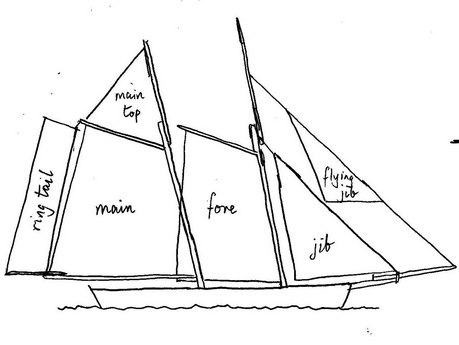
In 'Rope', Queeney traces the use of rope through time, from the earliest cordage made by Stone Age people to a projected future space elevator. The narrative is divided into sections, each of which addresses a different use of rope.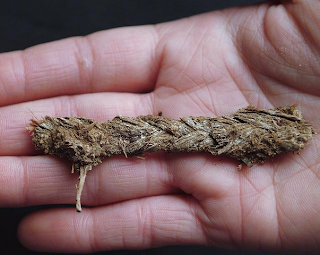
A remnant of prehistoric rope
In addition to 'the facts', Queeney - who's whimsical with a good sense of humor - includes related history; interesting anecdotes; snippets of interviews; tangential information; and more. Thus this is much more than a dry treatise on rope.
Children jumping rope
We don't know exactly when rope was first invented by prehistoric people, but whenever that was, it opened the door to an enormous array of new ways to save labor and improve the odds of survival....by being made into snares and fish-lines; tethers and leashes; nets; handles; and more. For instance, tying a sharp flint to the end of a stick made it a spear, so Stone Age humans could hunt animals for food.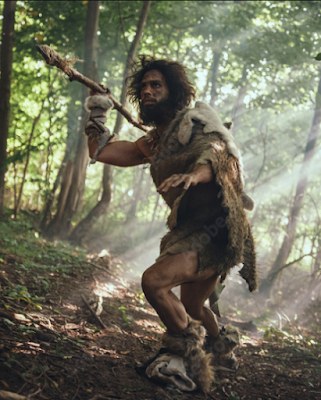
A more sophisticated use of rope was demonstrated by the ancient Egyptians, who used rope to lash together hulls of boats and to build pyramids, the most impressive of which were made between about 2600 and 2300 BCE. Queeney writes, "It was only by means of ropes that gangs of slaves could use their combined strength to move the high stones used in the construction of pyramids."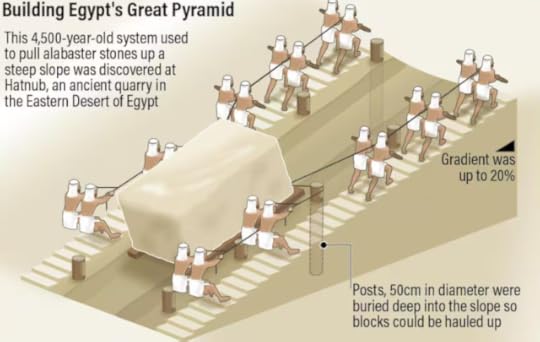
Other ancient peoples used rope to erect Stonehenge in England; Göbekli Tepe in Turkey; the Mayan and Aztec pyramids in Central America;, and the Stone Heads on Easter Island.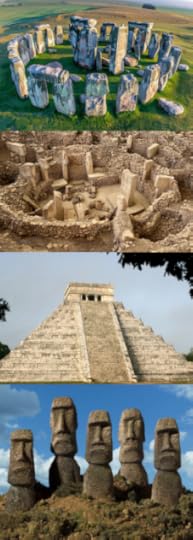
From top to bottom: Stonehenge, Göbekli Tepe, Mayan pyramid, and Stone Heads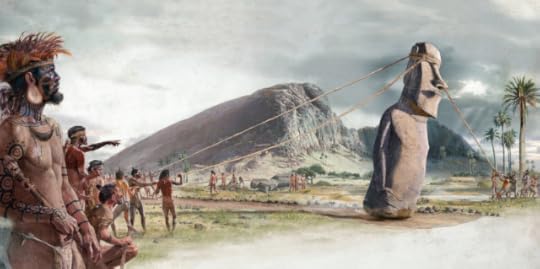
A depiction of ancient people raising a Stone Head on Easter Island
Among the most important uses of rope was for ocean-going vessels, which allowed ancient seafaring people to explore and colonize the world. For example, beginning around 3000 BCE Austronesian people from Taiwan made their way to the Philippines, Indonesia, Java, Sumatra, and the Solomon Islands. Queeney observes, "The expansion of Austronesian people across the Pacific was highly dependent on the use of rope. Their boats couldn't sail without it."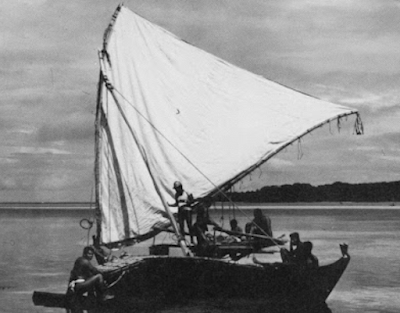
An Austronesian Rig
Queeney also discusses other seafaring civilizations, such as the Phoenicians, the Greeks, the Romans, and the Vikings.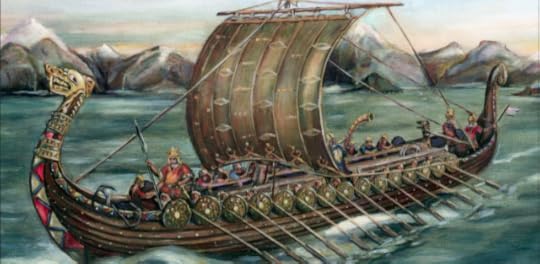
A Viking Ship
Note: Since Queeney is a seaman himself, all his 'boat chapters' tend to include descriptions of ship-building, propulsion, and navigation.....as well as the hazards of sea travel and the perils of the ocean. This is a bonus for interested lay people. 😊
More esoteric uses of rope - in the form of knots - was for good luck and spiritual/religious purposes. In ancient Chinese folk art, for example, good luck knots were used to ornament wind chimes, palace lanterns, sword hilts, teapots, hair pins, empress' hair, and more.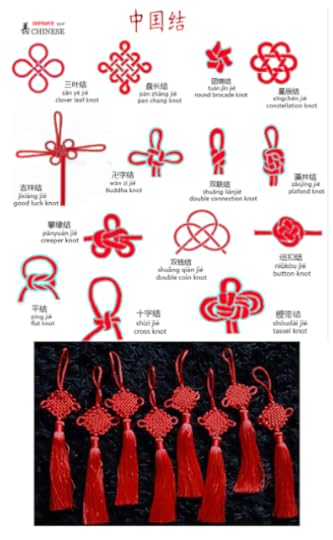
Traditional Chinese good luck knots
In other examples, the Endless Knot is a religious symbol in Buddhism; Solomon's Knot is associated with Judaism; and the Celtic Dara Knot is said to provide inner strength.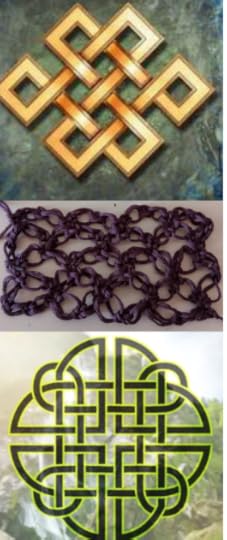
Top to bottom: Endless Knot, Solomon's Knot, and Celtic Dara knot
Historically, ropes and knots were also used to unite the hands of betrothed couples; to control the winds (supposedly); and to build cathedrals, temples, and mosques.
On a different tack, the Inka people used intricate assemblages of twisted cords they called 'khipu' for record-keeping. Khipu were composed of a horizontal cord to which numerous cords were tied and hung vertically. Each cord carried information encoded into it using a variety of characteristics, including the material from which it was made, the color of the cord, and also the number, type, and position of knots tied into it. Though researchers have decoded some khipu, ethnohistorians have not yet discovered a Rosetta Stone-type translation to decipher all of it.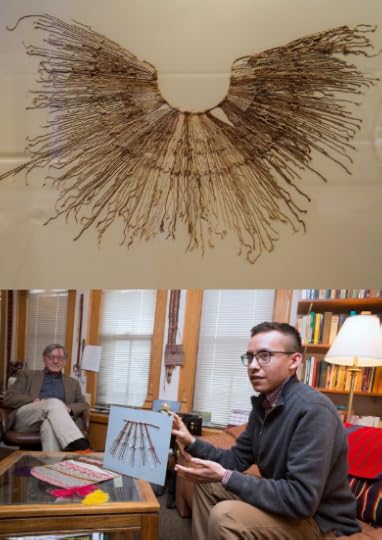
Top: Inka Khipu; Bottom: Khipu scholar Manny Madrano
Getting back to the ocean, Queeney discusses 'The Age of Sail.....and Rope' - from the mid-16th to the mid-19th century - when wind-driven ships ruled the seas. In addition to describing ships, sails, rigging, and knots, the author discusses exploration by European, Chinese, and Arab mariners. With a novelistic flourish, Queeney also depicts the harrowing battle between the USS Constitution and British warships during the war of 1812.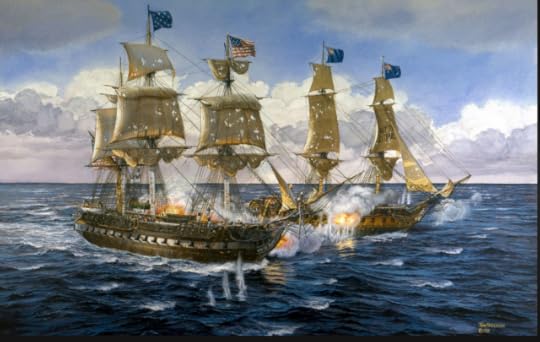
The USS Constitution versus British warships in the War of 1812
Besides ship-rigging, rope is used to make nets for the fishing industry, cords for lobster traps, and other such professional purposes.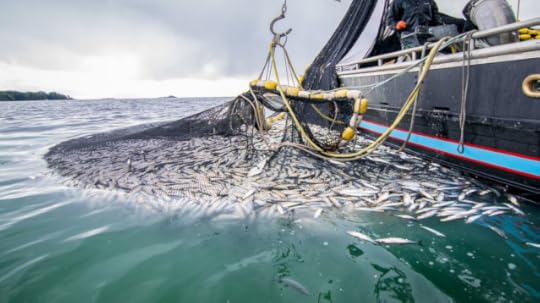
Net fishing with a boat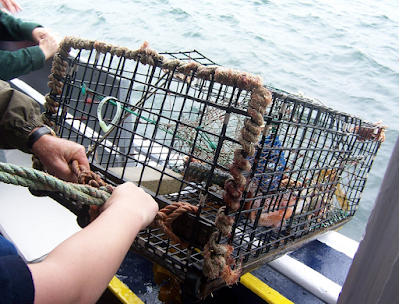
Pulling up a lobster trap
On a darker note, rope has long been used to punish people, by whipping, putting people on the rack, hanging, and lynching, Queeney provides many examples of these applications and - on the whole - it's a sad commentary on human nature.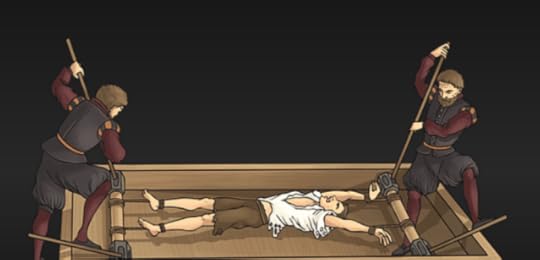
The rack was one of the most painful forms of medieval torture
On a lighter note, fans of westerns know working cowboys use ropes as lariats, to catch errant animals among other things. These 'work ropes' also came to be used for competitions and entertainment, as seen in rodeos.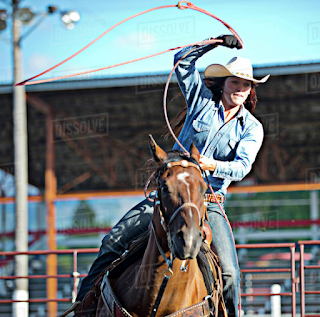
A cowgirl throwing a lasso in a rodeo
Additional uses of rope for entertainment and sports include: using rope to suspend actors, props, and scenery in theater productions; mountain climbing; spelunking; Double Dutch jump rope competitions; and on and on.
A Double Dutch jump rope competition
Rope made from organic materials, like hair, silk, cotton, hemp, sisal, manila, coconut, tree bark, etc. aren't suitable for all applications. As an example, the Brooklyn Bridge, a suspension bridge finished in 1883, uses rope cables made of steel. The bridge took 14 years to build and at least 20 people died during its construction.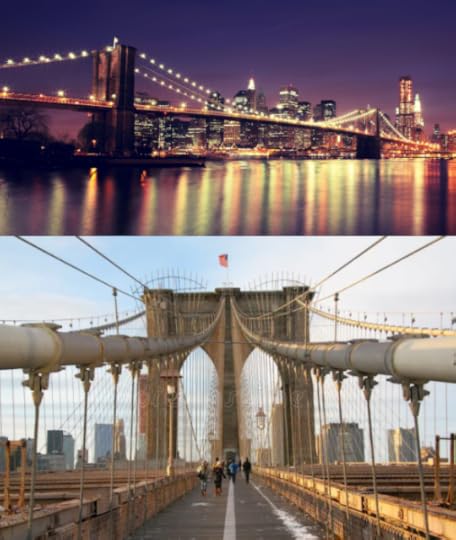
Top: The Brooklyn Bridge; Bottom: Cables of the Brooklyn Bridge
Metal cables were also used for the San Francisco and Chicago cable cars; the transatlantic underwater telegraph cable laid in the mid-1800s between Ireland and Newfoundland; and the cable used by tightrope-walker Philippe Petit to cross between the towers of the World Trade Center in 1974.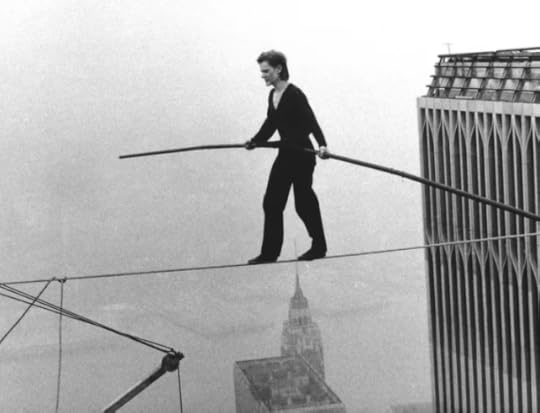
Philippe Petit crossing between the towers of the World Trade Center
Over the course of the book, Queeney writes about different kinds of rope, and the evolution of rope-making, from hand-cording; to using simple wooden aids; to Rope Walks; to machine spinning; to mechanical rope-making; to modern factories.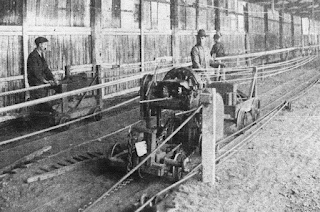
A Rope Walk operation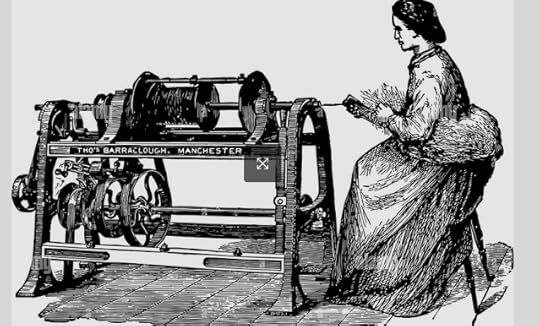
A woman spinning rope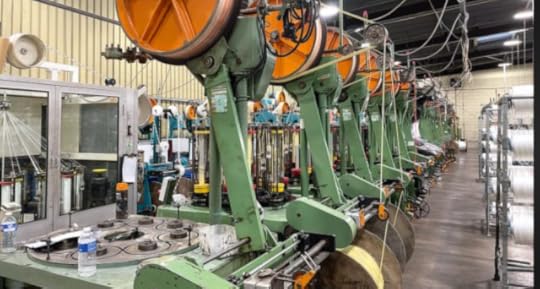
A modern rope factory
These days, much rope is synthetic, made from polymers like rayon, nylon, dacron, kevlar, and polyester, each of which has unique and useful properties. In fact, a synthetic rope called Technora was used to lower the Curiosity Rover to the surface of Mars.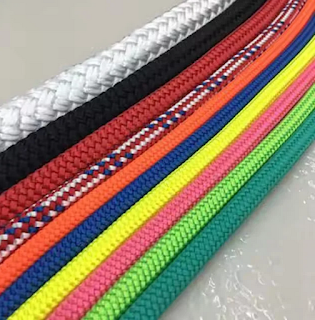
Polyester Rope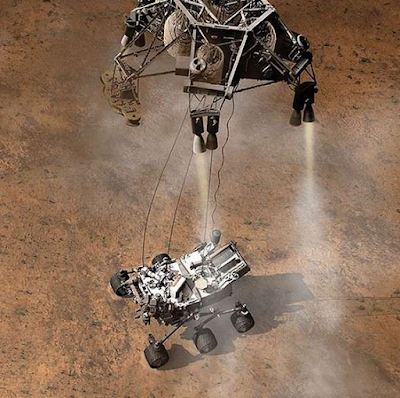
The Curiosity Rover landing on Mars
Looking to the future, scientists believe a carbon nanotube 'rope tether' will be used to construct a space elevator - a device that will leverage the rotation of the Earth (centrifugal force) to raise payloads to space.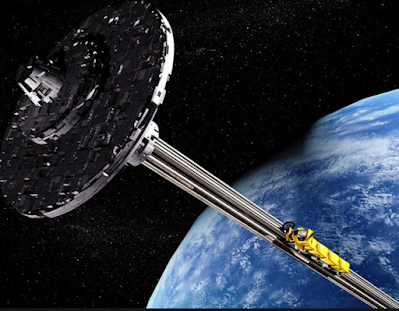
A carbon nanotube space elevator
Before reading this book I knew rope was useful for lots of things, but didn't think about rope much beyond that. This narrative taught me a lot about rope and I'd highly recommend it to interested readers.
Thanks to Netgalley, Tim Queeney, and St. Martin's Press for a copy of the book.
Rating: 4.5 stars

No comments:
Post a Comment