
In 'On the Set 0f Forrest Gump', American film producer Steve Starkey relates his experiences making the acclaimed movie Forrest Gump (1994), which won six Academy Awards. Starkey’s book is well-illustrated with photographs, and would appeal to fans of the movie as well as aspiring filmmakers.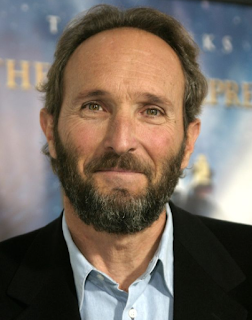
Producer Steve Starkey
In Starkey's own words, "Thirty years have passed since the release of Forrest Gump. It has been embraced not only by those who saw the film decades ago but also by a new generation of filmgoers. Audiences are still taken by the charming and likable character portrayed by Tom Hanks."
When we meet Forrest Gump in the film, he's a boy with an IQ of 75 who needs leg braces. Forrest's mother (played by Sally Field) is an indomitable spirit who makes sure Forrest gets proper medical care and goes to a mainstream school.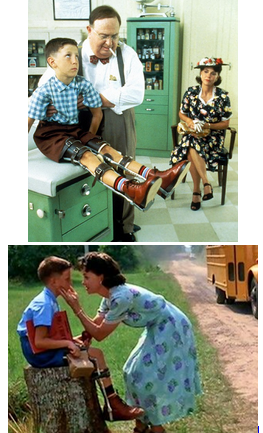
In time, Forrest sheds the leg braces, and - taught by his mama that the world is full of possibilities and he needs to use his God-given strength - Forrest learns to run.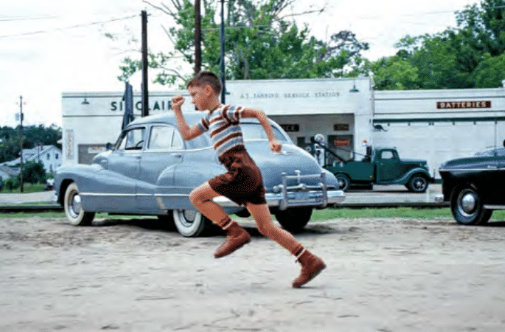
Starkey summarizes, "By running, [Forrest] was able to escape his boyhood tormentors. He excelled at football, allowing him to graduate from college and become an all-American. In Vietnam, he ran to save his life and the lives of the soldiers around him. Finally, he ran to overcome his grief over losing his mama and his love, Jenny. In running, Forrest found solace and discovered his destiny, as we each have to discover our own."
The book works best for fans familiar with the movie and the characters. For the layperson, the book reads like a brief on filmmaking, including 'tricks of the trade'.
*****
The making of Forrest Gump began when director Robert Zemeckis acquired the script and decided he would do anything and everything in his power to make the movie, along with his production partner Steve Starkey.
Director Robert Zemeckis
Paramount funded the movie and Starkey and his team proceeded to scout the many locations needed for filming. Starkey notes, "On this adventure we would travel into the Deep South and discover the world of Forrest Gump...Many locations were needed for the film, some in Washington, D.C., and some in Los Angeles [and some in North and South Carolina, Georgia, Maine, Montana, Arizona and more]. But we had to start in the South, painting with large strokes at first and fine-tuning as we went along." Additionally, the film spanned several decades, requiring period wardrobe, set dressing, and cars throughout.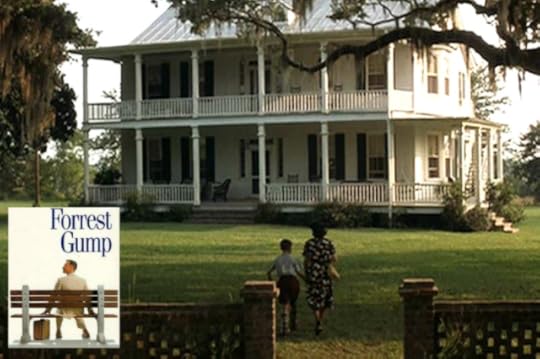
The Gump house in (fictional) Greenbow, Alabama
Starkey goes on to say, "On our distant locations, we had a lot of movies within the movie to prep. Not just the scenes in and around the Gump house and the town of Greenbow, Alabama, but also shrimping (including Forrest and Lieutenant Dan getting caught in a hurricane), Vietnam, the bench in Savannah, the sites in Washington, and Forrest’s run across the country. But the filming in the South took precedence."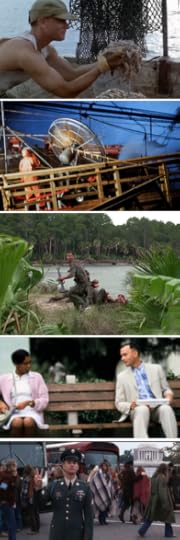
From top to bottom: Shrimping; Filming the hurricane scene required rain towers, jet engines, and fire hoses; Vietnam (really Louisiana); The bench in Savannah, Georgia; and Washington, D.C.
The movie received careful casting, and Starkey explains how the actors and extras were selected. Michael Conner Humphreys was chosen to play young Forrest Gump, and the boy was more interested in chasing lizards than acting. To motivate Michael, Starkey offered snacks and time off in exchange for Michael doing his running scenes.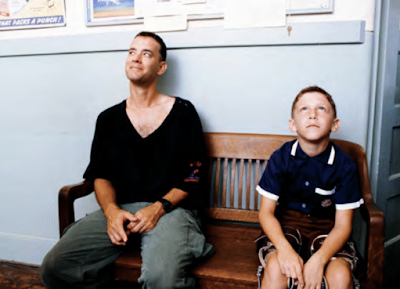
Tom Hanks with Michael Connor Humphreys, who plays young Forrest Gump
The running scenes for adult Forrest Gump required very careful planning. Starkey recalls, "Shooting the cross-country run became part of our life. How to pick up all the vignettes was a puzzle and, ultimately, a challenge. We grabbed shots whenever and wherever we could in the most imaginative ways possible."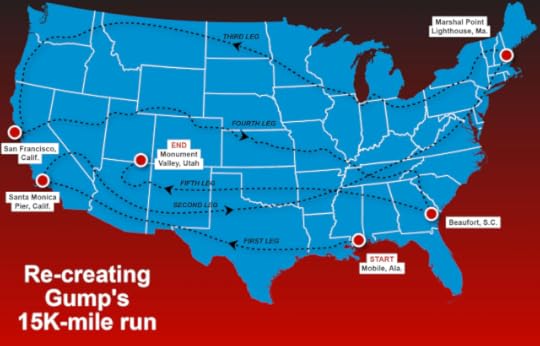
Momentum Films was hired to shoot the running scenes, and "they would be heading out soon to the wheat fields of Nebraska and the towering peaks of the Rocky Mountains before the seasons changed. We also wanted to hit New England at the peak of the fall colors. A series of these shots would be done without Tom. For his running double, Tom decided on his brother, Jim."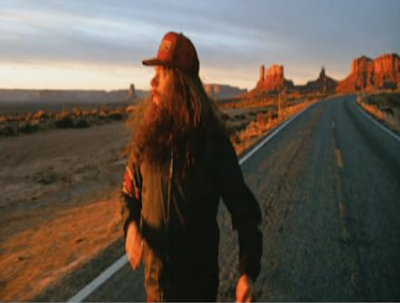
Forrest Gump runs through Monument Valley at sunrise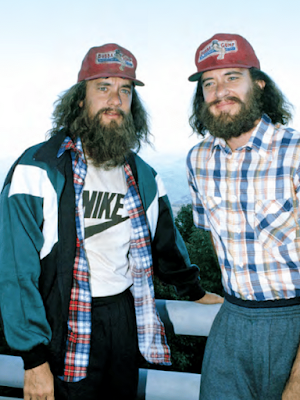
Tom Hanks with his brother Jim
In the movie, Forrest ran for three years, and the running sequence needed careful coordination among filmmaking departments, like wardrobe; hair; makeup etc. Forrest starts out clean-shaven, wearing a shirt and slacks, and - as he runs - his hair grows, his beard grows, his clothes change, and so on. However, the run was filmed piecemeal, as opportunities arose, so close attention had to be paid to Forrest's appearance in each shot. That is, Forrest might have a short beard and hair in a shot; then a long beard and hair in a shot; then back to a short beard and hair in a shot; and so on.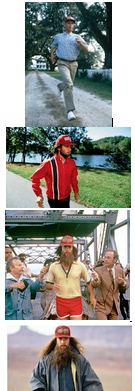
Forrest Gump's appearance changed over the course of his run
Starkey notes that the scenes set in Vietnam (really Louisiana) were challenging and dangerous. He recalls, "To protect the actors when they crossed the swamp in the rain, we set off explosive charges so no dangerous snakes would remain hidden in the marsh. We even wrapped wire mesh around the actors’ legs to prevent snakebites."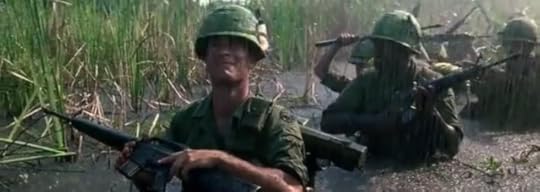
Forrest Gump's platoon slogging through swamps in Vietnam
Later in the movie, after an attack by the Viet Cong, Forrest carries one American soldier after another out of the jungle. Starkey writes, "Bob Zemeckis had designed the shot of Forrest emerging from the jungle with [his best friend] Bubba [played by Mykelti Williamson]...running straight toward the camera. Bombs were exploding close behind them. Since Mykelti was too heavy for Tom to carry while running, we did the scene in two parts. First we put Mykelti in a harness and suspended him on wires from a construction crane. As Forrest runs, cradling Mykelti’s body, we moved the arm of the crane forward."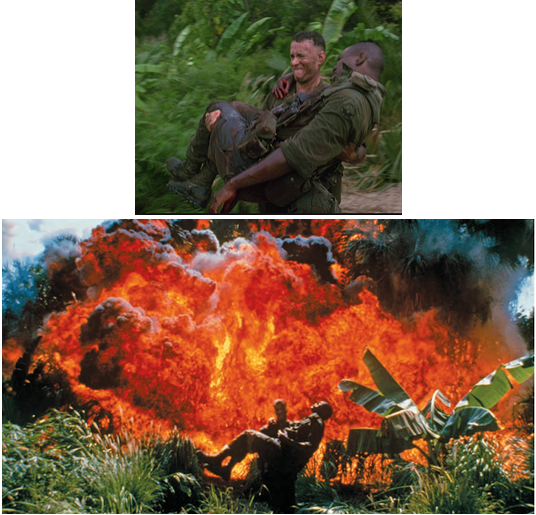
Scene of Forrest Gump carrying his best friend Bubba out of the jungle
In other scenes, Bubba talks about his dream of being a shrimper, and tells Forrest all about shrimp. In fun vignettes, Bubba says, "...Like I was saying, shrimp is the fruit of the sea...You can barbecue it, boil it, broil it, bake it, sauté it...There’s shrimp kabobs, shrimp creole, shrimp gumbo...pan fried, deep fried, stir fried. There’s pineapple shrimp, lemon shrimp, coconut shrimp, pepper shrimp, shrimp soup, shrimp stew, shrimp salad, shrimp and potatoes, shrimp burgers, shrimp sandwiches..."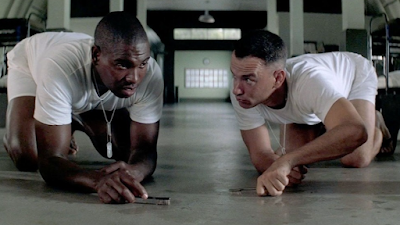
Forrest and Bubba cleaning the floor with toothbrushes while Bubba talks about shrimp
An important character in the film is Jenny, whom Forrest meets when they're schoolchildren, and who's the great love of his life. As an adult, Jenny (played by Robin Wright) is a hippy, drug-abuser, and troubled young woman who dates the wrong men. Forrest and Jenny repeatedly meet as their lives go forward, and their arc is vital to the story.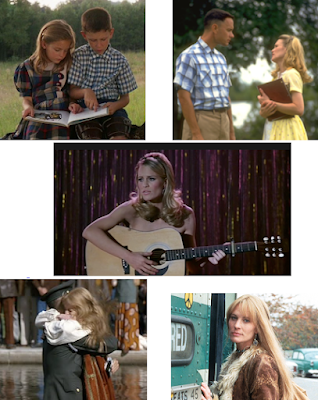
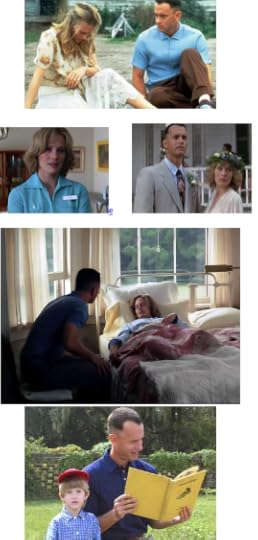
Sequence of photos: Forrest and Jenny are childhood friends; Jenny goes off to college; Jenny sings in a nudie club; Forrest and Jenny happen to meet in Washington, D.C.; Jenny leaves Forrest again; Jenny returns to Alabama for a brief visit; Jenny becomes a waitress in Georgia; Forrest and Jenny get married; Jenny dies; Forrest is with his and Jenny's son, Forrest Jr.
As the film's producer, Starkey - along with his excellent team - had myriad responsibilities. Starkey organized filming all over the country; handled the budget - which went over the allotted funding; determined the number of days for shooting - which went over as well; directed some scenes; arranged post-production; acquired the songs for the movie; and on and on.
Starkey writes, "I had been through some large-scale films -Roger Rabbit, the Back to the Future sequels, Death Becomes Her, and the Star Wars films...I knew what we were up against in post-production on Forrest. The visual effects alone were a challenge. It would take months to finalize each of the interactive scenes with Presidents Kennedy, Johnson, and Nixon, not to mention the one with John Lennon on The Dick Cavett Show...also a scene with Forrest and Governor George Wallace at the schoolhouse door.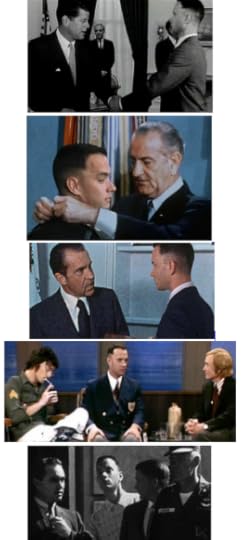
From top to bottom: Forrest Gump with President Kennedy; President Johnson; President Nixon; John Lennon and Dick Cavett; and Governor George Wallace
Starkey goes on, "Plus we had the crowd duplications in Washington, D.C., and the enhancements in the football stadium. We had to “remove” Gary Sinise’s legs in quite a few of Lieutenant Dan’s scenes (Lieutenant Dan is played by Gary Sinise). In addition, there were explosions, gunfire, and aircraft to put into the Vietnam sequence. Even the falling feather at the beginning and end of the film needed to be shot and inserted into its background.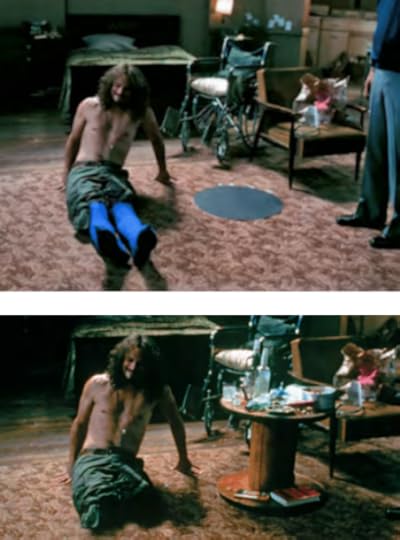
To remove Lieutenant Dan's legs (after he became an amputee), Gary Sinise wore special blue fabric stockings over his lower legs during filming. These were erased in post-production
In another interesting vignette, Starkey writes about Ping-Pong champion Forrest Gump playing Ping-Pong in China, a scene that became the film's greatest challenge. Starkey remembers, "For our film, we asked a professional Ping-Pong player to pantomime the game with Tom Hanks...Considering the competitive level of play depicted in the film, our game couldn’t be real...To re-create a game at the highest level, we explained to the pro that we’d be playing without a ball. That would be added later...The pro fell out of sync immediately. It turned out that he was somewhat like Forrest Gump: Give him a Ping-Pong ball and a paddle, and he knew what to do. Take the ball away, and he was lost." It all got worked out in the end though.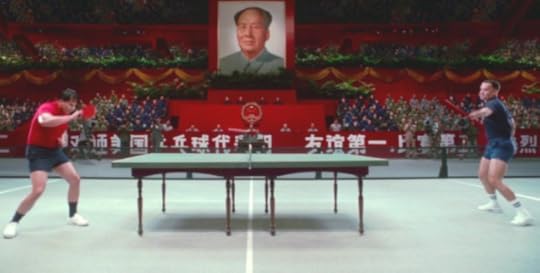
Forrest Gump playing Ping-Pong in China
Of course there's much more in the book, including LOTS of chitchat about the film going over budget. This angered the executives at Paramount, and Starkey endured the criticism. He observes, "On the set of Forrest Gump, I fiercely protected my crew from the punishing studio. I was unaware of the consequences of my actions, but I was willing to take responsibility for them; stupid is as stupid does, after all. It seemed like the right thing to do."
Starkey goes on to say, "Although [Forrest] called himself a simple man, Forrest’s rich moral fiber gave him strength and an uncanny ability to do the right thing. When I first watched the ending -when Forrest sits on the wall at the end of Oak Alley and watches the school bus carry his son to school, then stares off into space as a feather floats into the sky -I never knew how satisfied I would be decades later about a story so well told."
If you're interested in filmmaking, or just a fan of the Forrest Gump movie, this is a great book -chock full of interesting stories. Highly recommended.
Thanks to Netgalley, Steve Starkey, and University Press of Kentucky for an ARC of the book.
Rating: 4 stars

No comments:
Post a Comment