
The Spectator Bird won the prestigious National Book Award for Fiction in 1977. This is Wallace Stegner's second novel featuring Joe and Ruth Allston, but it works fine as a standalone.
Background: It's the 1950s, and Joe Allston - a New York literary agent, and his wife Ruth - an educated, socially active woman, rub elbows with writers, editors, critics, and erudite professionals.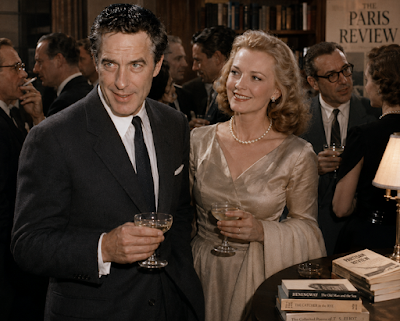
This contrasts with Joe and Ruth's son Curtis, a surfer who lives a counter-cultural, beach-oriented lifestyle with his drifter friends.
Joe Allston values stability, responsibility, hard work, and creating a legacy, which leads to constant arguments with his 'beach bum' offspring. Ruth is more conciliatory toward Curtis, but can do little to mitigate the discord between father and son.
When Curtis dies in a surfing accident (which may have been suicide), both Joe and Ruth are inconsolable, but Joe is also guilt-ridden, for his contentious relationship with his son.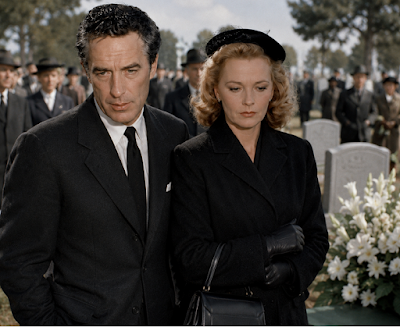
In the aftermath, Joe and Ruth move from New York to California's bay area, to grieve and heal.
*****
The Spectator Bird opens in 1974, when septuagenarians Joe and Ruth are well-established in their California 'retiree' neighborhood. Ruth is more socially active than Joe, and she constantly encourages her husband to get out and see people, fearing Joe will become depressed about his declining health and friends who've died or are terminally ill.
> 
Joe, however, prefers to stay home, take care of the property, and organize his papers for a memoir - which Joe knows he'll never write. Joe (who's the story's narrator) observes about himself: "[Joe Allston] has been a wisecracking fellow traveler in the lives of other people, and a tourist in his own. There has not been one significant event in his life that he planned. He has gone downstream like a stick, getting hung up in eddies and getting flushed out again, only half understanding what he floated past, and understanding less with every year. He knows nothing that posterity needs to be told about."
Joe's cynical view of his life is heightened by an afternoon visit from Césare Rulli, a larger-than-life, best-selling Italian writer with an eye for the ladies. Césare is disagreeably surprised when he realizes the Allstons didn't invite more luncheon guests to hear his clever repartee, and he and his pretty travel guide leave early. Before going, however, Césare chides Joe for choosing a dull life of comfort and respectability, rather than a life of fun, risk and excitement.
Joe's self-esteem is declining because this society does not value the old in the slightest, and Joe envies his 70-year-old doctor, who says he doesn't feel like an old man, but like a young man with something the matter with him.
The past comes calling when the Allstons receive a postcard, forwarded from their old New York address. The missive is from Countess Astrid Wredel- Krarup, whom the Allstons met when they visited Denmark two decades ago, after their son Curtis died. Joe's mother was an immigrant from Denmark, and Joe - having lost his only descendant - wanted to connect with his roots.
When Joe shows the postcard to Ruth, he also gets out a diary - composed of several notebooks - that he kept during the 1954 trip. Ruth was unaware of the journal, and asks Joe to read it to her. Joe admits, "I suppose I had no real chance, once I had let her know that the journal existed, of not reading it to Ruth, or at least letting her read it.....If I burn the things and declare that I will not be henpecked into spilling guts I no longer acknowledge, then I burn into her a conviction that certain aspects of the Danish episode were more important than in fact they were—that they left great scars on my soul. "
Joe reads the diary entries over the next few evenings, as Ruth relaxes in bed and Joe sits in his comfortable chair.
From here, the book alternates back and forth between the present, where the Allstons navigate their current lives, and the story told in the diary.
Joe's journal begins with the ocean voyage to Denmark, which occurs amidst ship-rocking storms that make Joe seasick.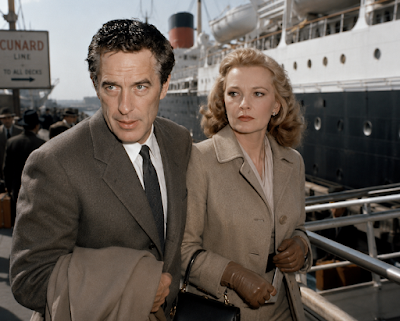
When a passenger dies from a heart attack, Joe describes the man's burial as follows: "A cluster of figures huddled out there, hanging on to each other or to the davits of a lifeboat, intent on something at their center. They hulked like conspirators, bent away from the wind and rain, and in my scared condition I had the wild idea they were planning like a lot of Lord Jims to abandon ship and let the pilgrims perish.....Then they fell back into a ragged line, two of them bent and lifted, and there went [the deceased] down the plank and into that appalling sea. There is no word for how instant his obliteration was. The second after they stooped, he was not."
The Allstons finally reach Copenhagen, and settle on accommodations with the financially strapped, fortyish Countess Astrid Wredel- Krarup. Joe writes, "The countess retains the front studio-bedroom, we take the drawing room, dining room, and back bedroom. We share the kitchen and one bath." The Allstons would probably have been more comfortable in their own apartment, but Joe writes, "Are we sorry for her because her husband ran out on her? Do we pity a woman who once had everything and now has to share the little she has left with strangers? Maybe."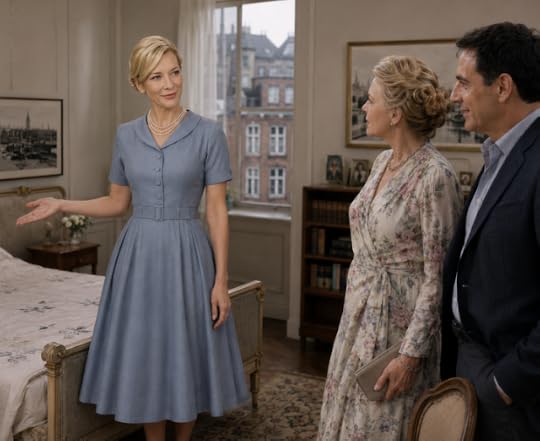
After the Allstons settle in, and Joe observes his wife and the countess returning from a shopping trip, Joe notes, "Ruth is small, the countess five nine or ten, with a vivid face and fine clear skin. She would be statuesque except that she is so animated. An almost feverish eagerness possesses her in conversation....Everything is so funny, or so wonderful, or so nice....Something in the way she moves. Is it breeding, or do they train them? American women who have what is called 'bearing' look as if they learned it in model school and need a mirror for its constant reassurance. This one, in her tweed suit and sensible walking shoes and utilitarian raincoat, throws it away and still has it."
And later on, when Joe and the countess go swimming in the ocean, Joe remarks on how young and beautiful Astrid looks, and how graceful and alive she seems outside the confines of the city. It's clear Joe is growing increasingly attracted to Astrid.
The Allstons and the countess occasionally do things together, like attending the opera, and Joe and Ruth notice that NO ONE speaks to the countess. In fact, people go out of their way to avoid her.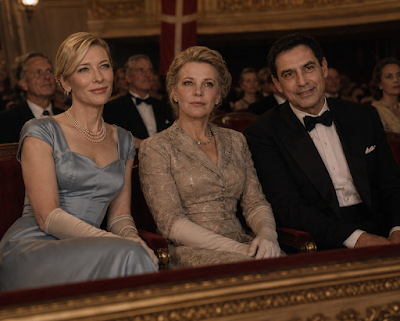
The countess confides that her estranged husband Erik "caught the Nazi disease" during World War II and is considered a quisling/collaborator. Astrid's family is notorious for other reasons as well, and no one in Copenhagen has spoken to her for the past nine years.
When the countess learns Joe's mother was a Sverdrup, she realizes Joe's ancestors must have lived near her own forebears in Lolland. So Astrid invites the Allstons to visit her family estate and castle, called Ørebyslot, in Lolland. Along the way, the trio picnics with Astrid's distant cousin Karen Blixen (author of 'Out of Africa'), who hints at dark secrets in Astrid's clan.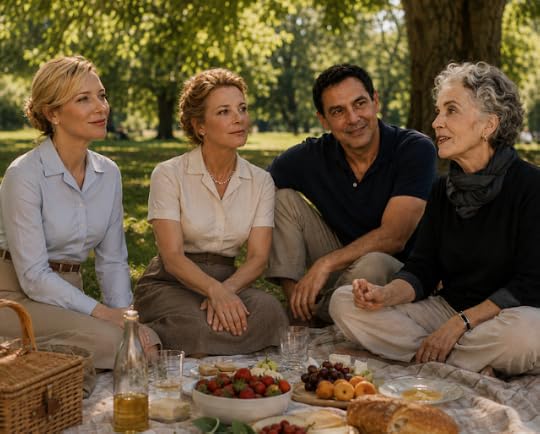
Afterward, the Allstons have an eventful visit with Astrid's relatives at Ørebyslo, and Joe gets a tour of the property, which is an outstanding example of farm management and conservation. Joe also learns more about his mother, who was a housemaid in one of the cottages on the estate.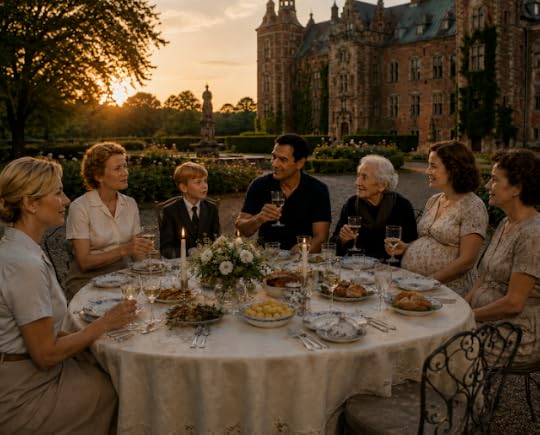
Some time later, back in Copenhagen, Astrid tells the Allstons about her family history. Astrid's father was the brilliant Danish scientist Aage Karl Rødding, and Astrid says, "The beginning is since many yearss, perhaps even before the beginning of this century. My father was interested in genetics, all kinds, but especially human, and that was hardest to study." Astrid relates many details of her father's research, and the studies he passed on to his followers. To say more would be a spoiler.
Later entries in Joe's diary reveal Joe's concern about Astrid's poverty and isolation, and his desire to help her, even to bring her to America. In the present, Ruth talks about Joe's obvious infatuation with Astrid, and the outcome of the visit.
For Joe's part, he's ambivalent about the past. On the one hand, Joe says, "I can't see that Danish episode as an adventure, or a crisis survived, or a serious quest for anything definable. It was just another happening like today's luncheon, something I got into and got out of." That's not true, of course, because Joe also thinks of "that possibility I had renounced, or been made to renounce, twenty years before and carried around with me like a cyst ever since."
Author Wallace Stegner is an erudite wordsmith who sprinkles his narrative with literary and historical references. The entire story is compelling, and I was especially interested in the research conducted by Astrid's father and his followers.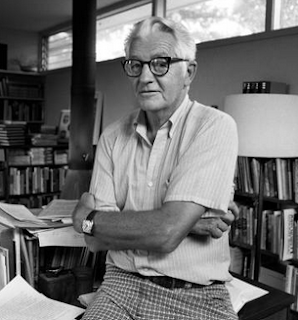
Author Wallace Stegner
Stegner's themes are aging, memories, missed possibilities, love, marriage, loss, grief, and ancestral roots. He also interested in the environment, and addresses irresponsible development in the California bay area, where the Allston characters live.
Recommended to fans of literary fiction.
Rating: 4 stars

No comments:
Post a Comment