
Author Natalie Lemle is a writer and art world professional who founded
the firm art_works, which helps corporations and private individuals
build and manage collections of contemporary art. In this novel, Lemle
uses an accusation against a museum to highlight aspects of archaeology,
looting of archaeological sites, cultural heritage, illegal sales of
historic artifacts, criminal involvement, government complicity, and
more.
Now on to my book review.
*****
It's 2022
and Lena Connolly, a trusts and estates attorney at a New York law firm,
is asked to assist on a cultural heritage case. Lena is told the firm
is representing Fordham University, whose museum is accused of housing
looted art. 
The
main item in contention is a dichroic glass cup with figures of Cupid
and Psyche. Italian authorities claim the cup was illegally excavated
and exported, and they want it back.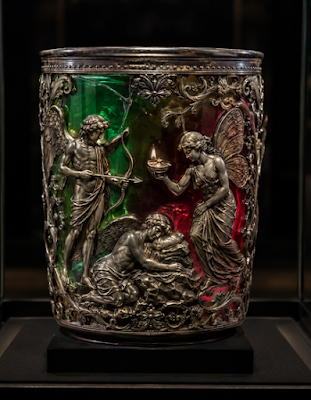
Lena's
fluency in Italian makes her an asset on the case, as does her summer
volunteer work on an archaeological dig in Orbagne, Italy in 2004. At
the time, Lena was an undergraduate at Columbia University, with an
interest in archaeology.
The story toggles back and forth between
2022 - when Lena is working on the lawsuit against Fordham, and 2004 -
during Lena's time on the Orbagne site.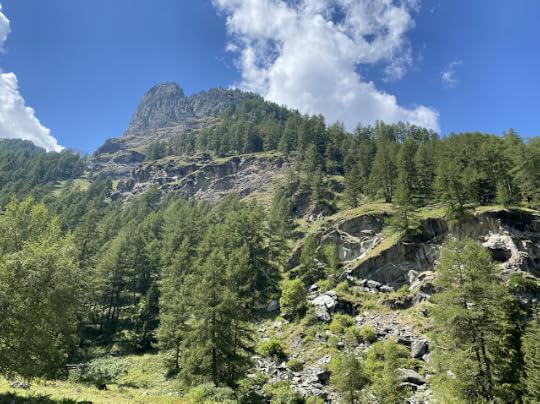
The
Orbagne dig involves the excavation of La Villa del Frutetto, an
ancient Roman villa with a surrounding farm and orchard. The project has
two co-directors: a French professor named Cyrille DuPuy - whose
archeology seminar Lena took at Columbia University; 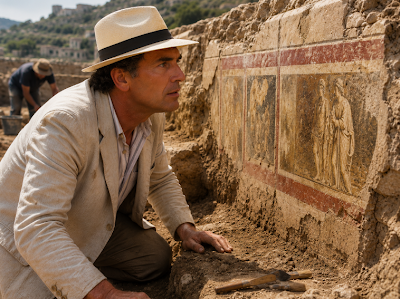
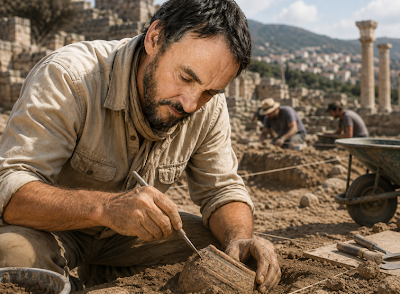
and Piettro Botti - an Italian archaeologist.
On
the dig, Lena describes removing wheelbarrow after wheelbarrow of
backfill from her assigned trench; using a trowel to excavate pottery
shards; being thrilled at the emergence of a fresco with a vivid red
top; documenting ancient finds; etc.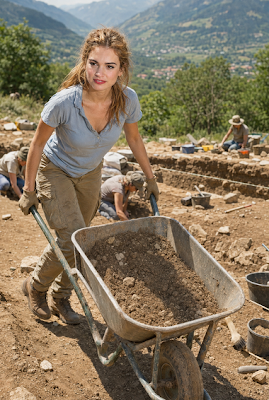
The
2004 chapters also include extensive discussions of Roman archaeological
sites as well as Roman history, architecture, aqueducts, mythology,
poetry, and literature - all peppered with Italian phrases as well as
Greek and Latin derivations of words.
As examples:
⛩️ ⛩️
Lena recalls her first conversation with Cyrille DuPuy at Columbia
University: "My dig, he said, is in the mountains. Near the
Petit-Saint-Bernard Pass - that is, where Hannibal made his crossing
with the Carthaginians. We will discuss the archaeology of this region
starting with the age of Augustus." And Lena thinks, "I knew about the
Punic Wars, about Hannibal charging over the Alps with his elephants -
but I knew nothing about ancient life in those mountains: the stone
monuments the Romans went on to destroy and replace with their
amphitheater, villas, and temple to Jupiter."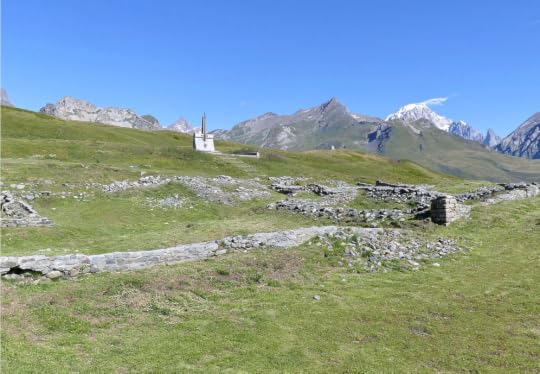
The foundation of the Roman temple to Jupiter near the Petit-Saint-Bernard Pass
⛩️
⛩️ Looking at a poster of 'The Feast of Achelous', Lena thinks, "Every
time I look at it I see something new: a shell in the lining of the cave
walls; a detail in one of the ancient vessels on the ground; a new
facial expression on one of the figures facing Achelous the river god,
who gestures to the water where his lover Perimele has been turned into
an island by Neptune so he can hold her in an eternal embrace."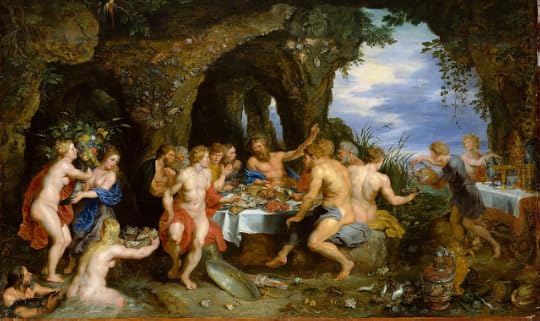
⛩️
⛩️ Learning that a Roman mansio (stopping place for rich travelers) has
a "fanum" dedicated to the goddess Epona Augusta, Lena observes, "I
looked it up and learned it was the etymological root of the word
profane. A fanum was a Roman temple built over a Gallic sacred place.
Something that was profane was not sacred, because it was "pro" -
outside of - a "fanum."
I felt like I was getting an education along with a novel.
Getting
back to the story, while Lena is working in Orbagne she falls in love
with Giamma Piromalli, a handsome Italian who's working on his PhD in
art history. Lena is disturbed to learn Giamma's father has ties to the
'Ndrangheta (the Calabrian mafia), reputed to be ruthless men who loot
archaeological sites, traffic in stolen antiquities, and traffic
cocaine. It later appears the 'Ndrangheta may have been implicated in stealing and
selling the dichroic cup. 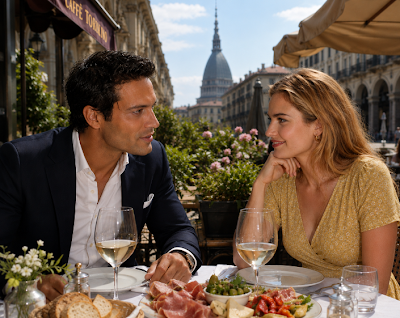
That's
not the only trouble in Orbagne. There's minor looting before the dig
begins; there's friction between the co-directors; and Cyrille DuPuy
disappears one morning, and no one seems to care. Lena goes to the
police about her former professor, but they refuse to take a report and
tell her to go to the French authorities. Cyrille's disappearance still
haunts Lena twenty years later, and she uses Italy's lawsuit against
Fordham as an excuse to return to Orbagne and look around. 
In
the chapters set in 2022, the accusation against Fordham gives Lena the
opportunity to familiarize herself with matters surrounding art theft.
Buying and selling antiquities (or donating them for a tax break)
involves issues of provenance, export licenses, due diligence,
ownership, ethics, cultural heritage, historical preservation, art
repatriation, and so on.
For instance:
⛩️ ⛩️ "The book
'Art Crime' by John Conklin stated that art theft was the third-largest
area of international crime, after drug smuggling and arms trading...the
plundering of ancient sites for artifacts comprises nearly 90 percent
of all art theft transpiring in the world today."
⛩️ ⛩️ Speaking
about art donations, an expert says. "Ever since the tax code was
changed...I've been advising my clients to donate valuable artworks
within their lifetime in order to reap maximum benefits....My client
with the Limoges enamels, for example...reduced his tax bill by 60
percent the year he donated to the Frick."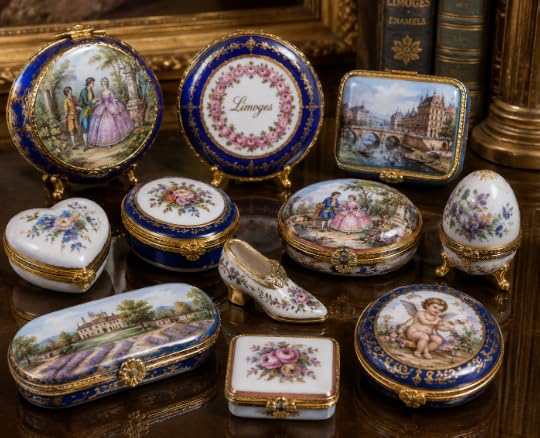
⛩️
⛩️ Referring to cultural heritage law, an attorney says, "My team won a
case a few years ago, brought against an art dealer who was implicated
in selling Nazi-looted paintings to some oil family in the fifties...The
case fell under government enforcement and compliance. The court was
determined not to have jurisdiction. The claims were dismissed."
Once again, I felt like was learning a good deal.
The suspense aspects of the novel are augmented by issues in Lena's personal life.
To illustrate:
⛩️
⛩️ Lena had a terrible childhood with a (now deceased) mentally ill
mother and absent father; Lena is now completely estranged from her
father and won't even speak to him.
⛩️ ⛩️ Lena's older sister
Jinny is pregnant, which causes Lena angst. Lena observes, "When she
told me about the pregnancy...I was only thinking about nature versus
nurture, and inheritance, and of Jinny and I cowering on the beige
living room couch in our childhood home during our mother's paranoid
tirades."
⛩️ ⛩️ Lena is close to her best friend Lakshmi, whom
she met in her Columbia archaeology seminar. The women spend time
together, speak on the phone, confide in one another, and so on. This
appears to be the most positive relationship in Lena's life.
All this helps round out the novel.
I
liked the book's historical and technical details, and didn't mind
looking up the meaning of the many Italian phrases. On the other hand,
some of the book's suspense elements are murky and confusing. That said,
I enjoyed the story and recommend it to readers interested in the
subject.
Thanks to Netgalley, Natalie Lemle, and Simon & Schuster for an ARC of the book.
Rating: 3.5 stars

No comments:
Post a Comment