
Lois Romano is a national journalist who was an editor, political
writer, and columnist for The Washington Post and Politico. In this
book, Romano amends the maligned reputation of Mary Todd Lincoln, who
was vilified during her life, and even more fiercely criticized
afterwards.
Romano writes, "My purpose is not to excuse or
whitewash Mary's behavior. Her actions were, at many times, egregious.
She could be self-centered, dishonest, and tone deaf. But much of the
criticism was one-sided and heartless, rarely taking note of her acts of
kindness and generosity....By re-examining factual accounts and primary
source documents through the lens of both modern medical science and
contemporary standards for women, I have tried to piece together a more
complete and compelling portrait...of a woman of uncommon tenacity in
the face of extraordinary adversity, personal shortcomings, and
torment...That she persevered in the face of overwhelming grief, poor
physical and mental health, and public scorn was a testament to her
mettle."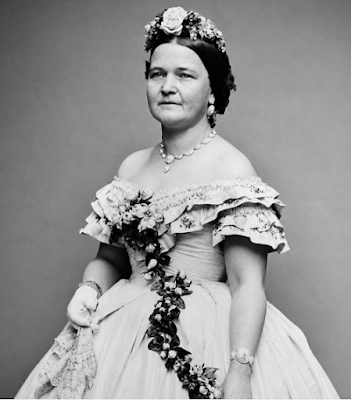
Mary Todd Lincoln
Mary
Todd was born in Lexington, Kentucky in 1818. Her parents, Robert Todd
and Eliza Parker Todd, belonged to prominent families that boasted
military heroes, landowners, bankers, merchants, governors, doctors,
ministers, and U.S. senators. Mary was 6-years-old when her mother died,
and sixteen months later her father married Betsy Humphreys who
"inherited six young children to raise....and gave birth to nine more
children, eight of whom survived."
This was difficult for Mary,
and Romano believes it contributed to Mary's future emotional problems.
In any case, Mary had a fine education with a curriculum that combined
"rigorous academics and French language immersion with tutoring in the
refinements associated with social class, including acting and dance."
Mary Todd Lincoln was one of the few first ladies in American history to have a
more formal education than the sitting president.
Growing up in
Lexington, Mary was confronted with the nation's most controversial
issue: slavery. Mary's family owned slaves, and Lexington was home to
one of the South's most notorious slave markets "where Negroes [were]
flogged unmercifully." Mary's changing views on slavery were shaped by
her upbringing, her exposure to brutal treatment of slaves, and her
neighbor (and idol) Henry Clay's opposition to slavery.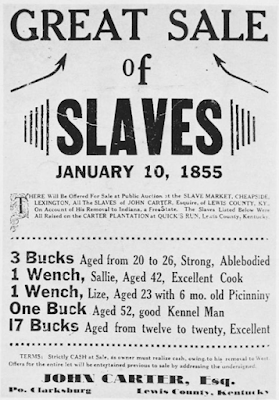
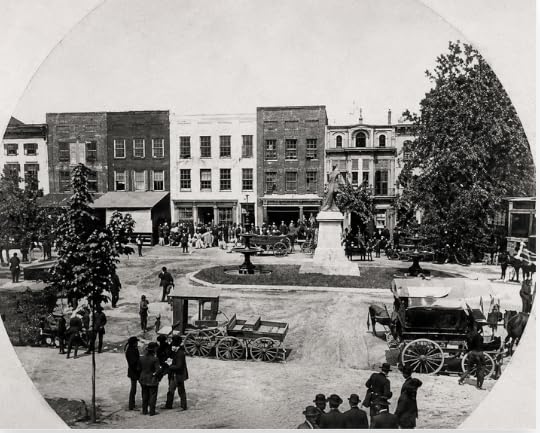
Slave auction on Cheapside, Lexington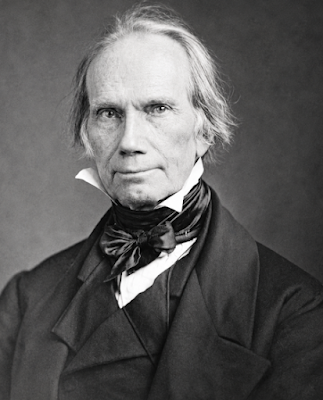
Henry Clay
When
Mary was twenty-one she left Lexington and moved to Springfield,
Illinois to live with her married sister Elizabeth. Having an interest
in politics, Mary got to know Abraham Lincoln, who "was thirty, a rising
star in the Whig Party and Illinois politics, and an orator and
raconteur of some skill." 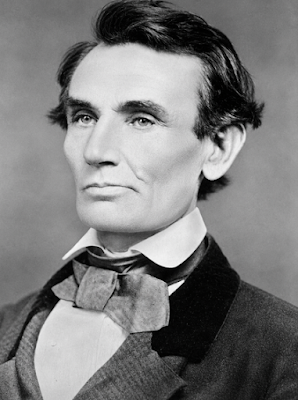
Abraham Lincoln
Romano
describes Mary and Lincoln's tumultuous romance, which ended in
marriage in 1842, when Mary was twenty-four and Lincoln was
thirty-three. The Lincoln's lived in two temporary residences before
they settled into their house on Eighth and Jackson Streets in 1844.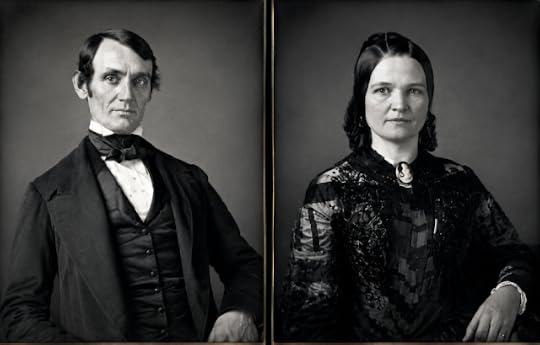
Abraham Lincoln and Mary Todd Lincoln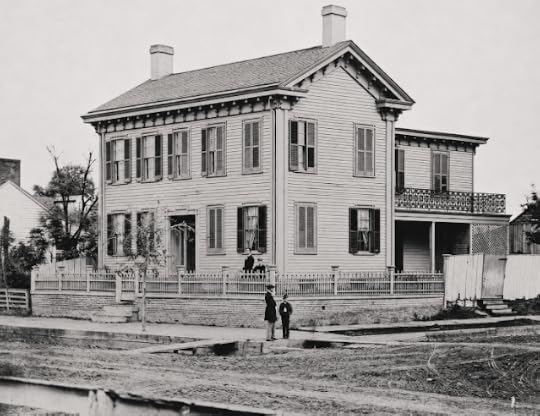
The Lincolns' home on Eighth and Jackson Streets in Springfield, Illinois
In
later years, Mary and Abe's on-and-off romance was used to denigrate
Mary, with "no shortage of males claiming that Lincoln, did not marry
for love...but because he felt honor bound." This story was largely
spread by Lincoln's one-time law partner William Herndon, a scoundrel
who made a career of tearing Mary down. Afterwards, writers and
biographers repeated Herndon's tale so many times, "it became embedded
in history."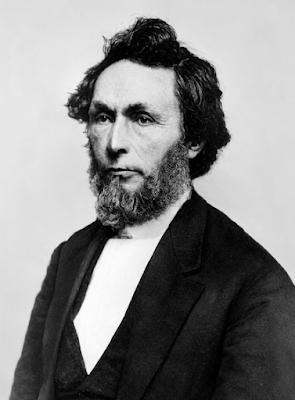
William Herndon
Romano
cites evidence of Lincoln's deep affection for Mary, including many
tender letters; Lincoln calming Mary during her emotional episodes; and
Lincoln hurrying to wake Mary after 1860's presidential election,
saying, "Mary, Mary, we are elected."
Romano writes a good deal
about Lincoln's political career, and emphasizes Mary's active interest
and assistance. Mary resented anyone she thought failed to support
Lincoln or blocked his advancement, and her grudges were fierce and
long-lasting. As an example, William Seward was Lincoln's rival for the
Republican presidential nomination in 1860, and after the election, Mary
STRONGLY opposed Lincoln making Seward Secretary of State. Lincoln did
anyway, and the two men eventually became strong allies. Contrariwise,
Mary didn't forgive and forget, and her snubs sometimes embarrassed the
administration and made enemies for Mary herself. Sadly, Mary
cold-shouldering William Herndon may have been a factor in his long
campaign to tear her down.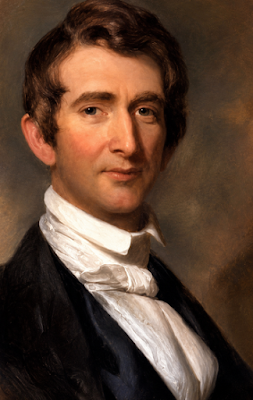
William Seward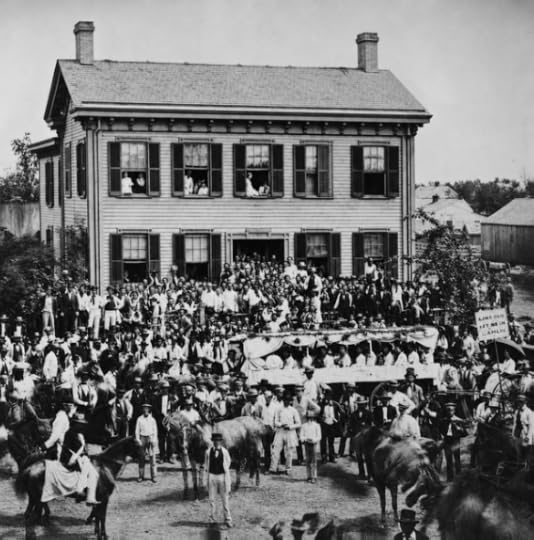
Republican campaign rally at the Lincoln home in August, 1860
The
issue of slavery was at the center of Lincoln's presidency, and Romano
describes Lincoln's progress from trying to prevent slavery's expansion;
to using emancipation as a weapon of war; to the abolition of slavery.
Mary was on board with Lincoln every step of the way. Nevertheless,
Lincoln's enemies attacked him through Mary, saying she supported the
Confederacy, and citing the fact that Mary's family owned slaves, and
many of her male relatives joined the Confederate Army. In fact, it's
well documented that Mary often visited Union military hospitals,
bringing flowers, fruits, and food, and speaking with the soldiers.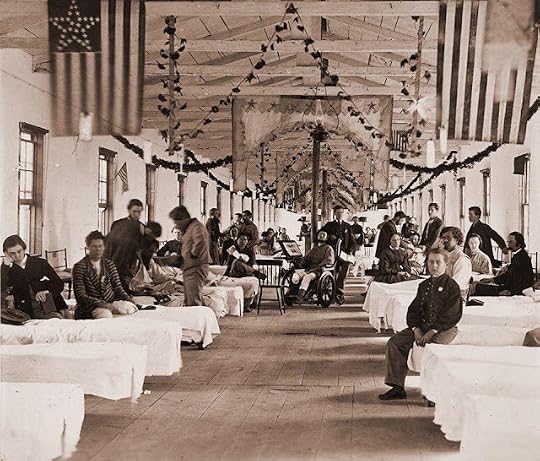 Mary Lincoln often visited Union military hospitals like this one
Lamentably,
Mary's reputation was harmed by the fact she combined support for the
Union with shopping. When Mary visited Philadelphia and New York for
pro-Union events, she took the opportunity to shop at luxury stores to
spruce up the White House. Mary purchased a grand piano, draperies,
Parisian wallpaper, a rosewood bed frame, luxurious carpets, silver,
chandeliers. fine French china, and more. Romano writes, "As the
government was struggling to pay for the war, Mary was being savaged by
Lincoln's detractors for her lavish shopping." 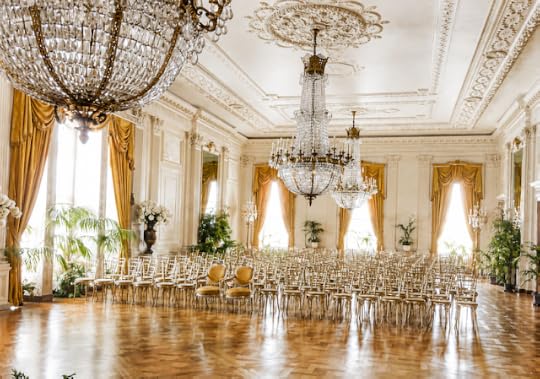
The East Room after Mary redecorated it
Romano
believes Mary was (what's now called) a compulsive shopper, evidenced
by the fact Mary had "eye-popping debts from her impetuous shopping
sprees." The author writes, [Mary] had amassed a collection of fine lace
dresses, luxurious furs, 300 pairs of gloves, and jewels, all on
credit...Mary's spending had continued, unabated and unchecked, for five
years [while Lincoln was president]." After the assassination, "The
ride was over. Now all the merchants and banks from which she borrowed
were demanding payment."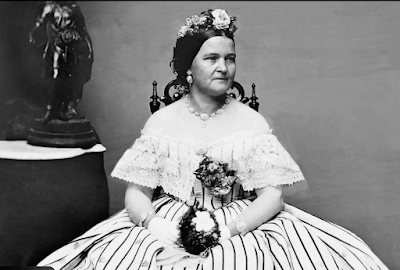
Mary Todd Lincoln dressed in her finery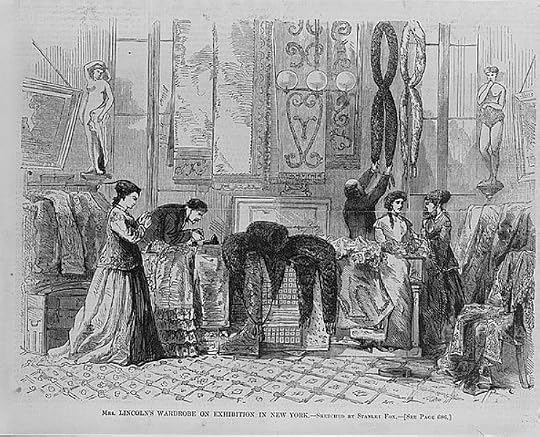
An exhibition of Mary Todd Lincoln's wardrobe in 1867
Of
course Mary was devastated by Lincoln's assassination in 1865 (which
Romano describes), and the situation was made worse by Mary's
destitution. It took years for Lincoln's estate to be settled, and
meanwhile, Mary had very little money. Romano documents this in detail,
and describes Mary obsessively soliciting money from influential and
wealthy people. Other aspects of Mary's misbehavior, both during her
marriage and widowhood, are documented by Romano, who acknowledges it's
all fuel for Mary's critics. Still, Romano excoriates biographers for
being HUGELY biased against Mary, and being unsympathetic to Mary's
physical and mental illnesses, and the tragedies in her life.
Mary
lost three of her and Abraham's four sons: Eddie died in 1850, at the
age of three, probably from tuberculosis; Willie died in 1862, at the
age of eleven, probably from typhoid; and Tad died in 1871, at the age
of eighteen, from a respiratory infection. The only Lincoln child who
survived to adulthood was the oldest son, Robert.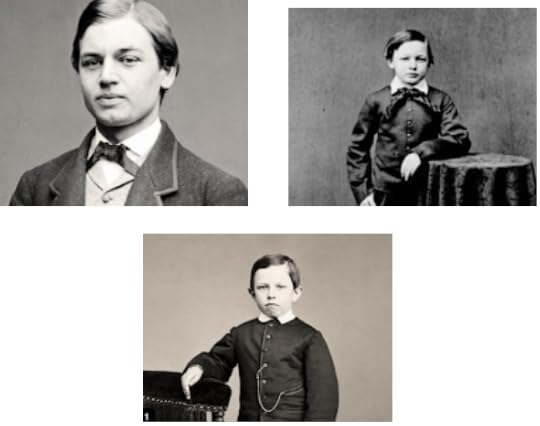
The Lincolns' sons: Robert (top left); Willie (top right); and Tad (bottom)
Mary's
deep mourning for her children and husband drove her to consult
spiritualists, which led to 31-year-old Robert organizing a trial to have his mother
committed to an insane asylum in 1875. With help, Mary soon got out, and was almost
completely estranged from Robert after that.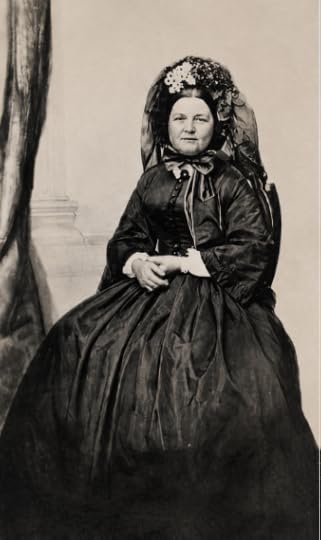
Mary Todd Lincoln in mourning clothes after Lincoln's assassination
Mary surely deserved sympathy for all this trauma, but her detractors were largely unable to provide it.
Mary
spent large portions of her later life in Europe, both to prevent
Robert from trying to institutionalize her again, and because the
continent was more economical for a single woman. During her final
years, Mary lived with her sister Elizabeth in Springfield, Illinois,
and she died in 1882, at age 63.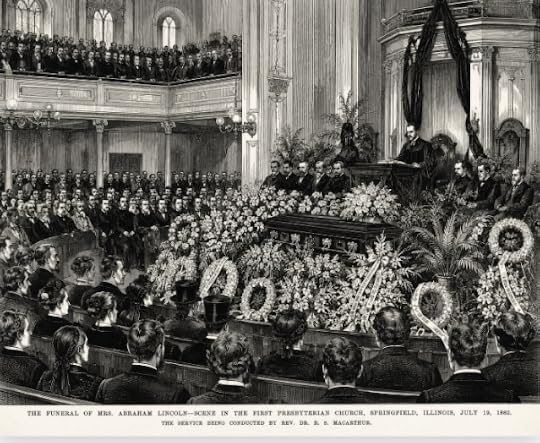
The funeral of Mary Todd Lincoln
Mary's
legacy was largely defined by the misogynistic men who wrote her
biographies. Many were influenced by William Herndon's infamous libel,
which was accepted as truth. Others believed women should remain in
their place in a man's world, and Mary was ostentatious and flamboyant. I
think Romano does an admirable job correcting the record.
This is an important book that I'd recommend to all readers interested in American history.
Thanks to Netgalley, Lois Romano, and Simon & Schuster for an ARC of the book.
Rating: 4.5 stars

No comments:
Post a Comment