
I first read C.P. Snow's 'Strangers and Brothers' series some time ago,
and it became a favorite. The novels focus on an English barrister/civil
servant, Lewis Elliot, who rises from poverty to a position of
influence in the early-to-mid 1900s. Elliot is present in the entire
eleven-book series, but he's not always the central character.
Storywise, 'George Passant' is the second book in the series.
*****
Lewis Eliot was a junior clerk in his town's 'Council Education Office' when he first met George Passant.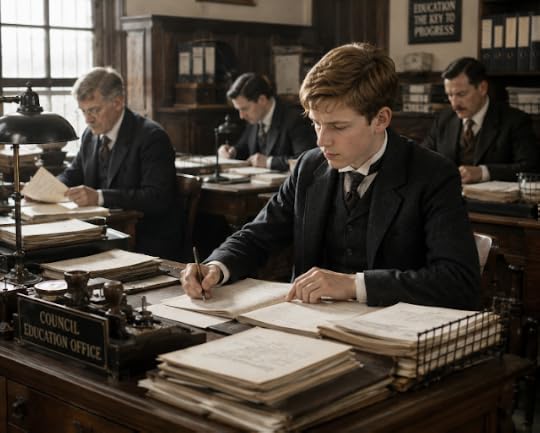
Lewis
took night classes at the local College of Art and Technology (aka the
School), and George, a solicitor/managing clerk at the law firm Eden
& Martineau, taught Fundamentals of Criminal Law.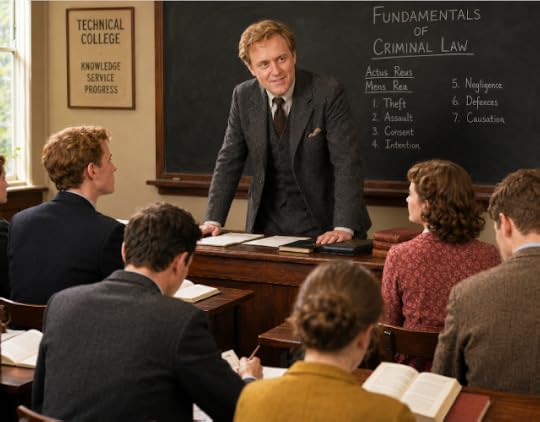
Lewis
was drawn into George's social circle, a cluster of young people
(called 'the group') that George - then in his mid-twenties - collected
around him. All the group, both men and women, were students at the
School. The group often met in cafés.....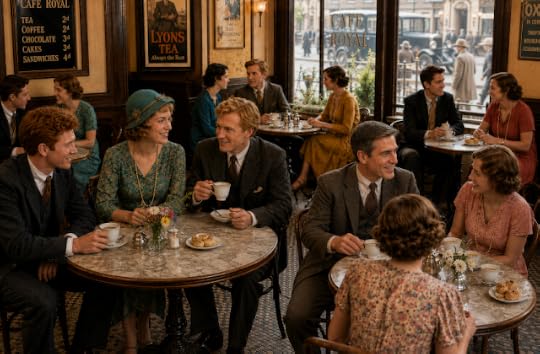
......
and then developed the practice of spending weekends at a farmhouse ten
miles away, where they would cook their own food, pay a shilling a
night for a bed, and talk until daybreak. 
*****
When
the novel 'George Passant' opens around 1930, Lewis is a London
barrister in his mid-twenties, and George - now in his early thirties -
is still just a solicitor/managing clerk at Eden & Martineau. George
hopes to be made a partner, but Mr. Eden disapproves of George's 'way
of life' and won't support a promotion.
George
has continued to maintain his social circle (the group), which still
spends weekends at a farmhouse in the country. The group is composed of a
cadre of young people who admire George for his independence and
visionary ideas. George encourages his adherents to think for
themselves, reject social conventions, and pursue their dreams.
George
does everything he can to support his followers. Thinking of his own
time in George's circle, Lewis recalls, "George had set us moving, lent
us money....it was the first time we had been so near to a
generous-hearted man...We became excited over the books he told us to
read and the views he stood by, violent, argumentative, four square. We
were carried away by his belief in human beings and ourselves."
George's
support for a charismatic young man in his group, Jack Cotery, has
serious repercussions. Jack works for a newspaper publisher named Mr.
Calvert, who helps pay for Jack's printing classes at the School. 
When
Mr. Calvert's teenage son Roy develops an innocent crush on Jack, the
publisher gets angry and withdraws his financial support for Jack's
classes. George intervenes and gets a partial victory, but Jack still
can't afford to continue his education.
Jack is an enterprising
fellow however, and he embarks on a series of financial schemes, some of
which skirt the law. Jack convinces George to be his partner in two of
these enterprises.....
.....and
before long, the authorities accuse George, Jack, and Jack's girlfriend
Olive Calvert of financial fraud - specifically misleading investors to
get money.
Lewis Eliot becomes the group's barrister, to defend them in court.
Of
course, Lewis's major concern is his friend George, who's VERY NERVOUS
about the upcoming trial. When Lewis reads George's diary to prepare for
the case, he realizes why.
George's
journal contains passages like, "This randy fit is going on too long.
Last night I could not resist taking the train to London. I was inflamed
by the vision of one of our prettiest [prostitutes].....Tonight it was
still on me. I took the familiar train to Nottingham. I found a pair of
old friends in the first pub...but they were booked...so I moved on. I
have hazy recollections of hordes of women that I kissed."
Worse
yet, George's diary refers to Katherine, and Freda, and Daphne, all
young women in George's group. In Lewis's time, George would have considered it COMPLETELY INAPPROPRIATE to sleep with women in his
circle; however, George's desires apparently got the best of him. In
fact the farmhouse is the site of rampant sexual activity among people
in the group, and George is terrified this will come out in court.
We follow along as Lewis Eliot and his former boss Herbert Getliffe defend George and his alleged co-conspirators.
That's the core of the story, with tangential action that adds interest to the narrative. For instance:
🔴
Mr. Martineau (of Eden & Matineau), a capable and respected
solicitor, undergoes a religious conversion. He becomes a devout
Christian, leaves the law firm, gives away his money, and becomes a
member of 'The Brotherhood of the Road.'
🔴
Olive Calvert, a young woman from a wealthy family, seems to have no
direction in life. She dallies with the rapscallion Jack Cotery as well
as a respectable educated man called Arthur Morcom, who pines for her. 
🔴
George has troubles besides the lawsuit. He's frustrated about doing
most of the work at Eden & Martineau while being paid a managing
clerk's salary; he could help himself by attending Eden's soirées, but
he gets awkward among upper class people; his current girlfriend Daphne
is maneuvering to marry him; and he must help his parents financially,
but spends too much money on himself (wink wink).
As before, there's a good bit of British slang in the book. For instance:
🔴
Mr. Eden tells Lewis an older barrister must assist him for George's
trial, saying, "[The jury would] resent all the [youthful] brilliance
right from the start. You'd only have to make a clever suggestion, and
they'd distrust you. They'd be jibbing from all the good qualities of
your generation..." (In this context, 'jibbing ' means resisting,
ignoring.)
🔴
George's mother is talking about Mr. Martineau doing a bunk saying,
"That's the place old Mr. Martineau started his acting tricks, isn't it?
I should like to know what culch he's getting up to now." (In this
context, culch means foolishness.)
🔴
George has an entry in his diary that reads: "The last weekend was full
of drunken nights, of decrepit nights. I went to Nottingham, finding
money drip away as usual. I was still on the hunt and finished at
Connie's....Then I realized once again that no other girl of the past
year is fit to take her place. I just had time for a huzzlecoo; then I
went back on the last train. (In this context, huzzlecoo means a
romantic interaction.)
This isn't among the most compelling books in the series, but it's an engaging tale that's important to the continuing story.
Rating: 4 stars

No comments:
Post a Comment