
In essence, this novel is about the marriage of Susan Burling Ward and
Oliver Ward, which lasted for 60 years, from 1876 to 1936. As material
for the fictional story, author Wallace Stegner used the REAL letters of
Mary Hallock Foote, born to a Quaker family in 1847.
In his
acknowledgments, Stegner writes, "My thanks to J.M. and her sister for
the loan of their ancestors. Though I have used many details of their
lives and characters, I have not hesitated to warp both personalities
and events to fictional needs. This is a novel which utilizes selected
facts from their real lives. It is in no sense a family history."
Still,
after Angle of Repose won the Pulitzer Prize in 1972, controversy broke
out, and Stegner was accused of being a plagiarist and misusing the
letters.
*****
As the novel opens in 1970, Lyman Ward - a
retired history professor who taught at Berkeley - is living in Zodiac
Cottage in Grass Valley, California. The professor is in a wheelchair,
having lost one leg to bone disease. Long-time family employees Ed and
Ada Hawkes live in a cottage down the hill, and Ada comes over every day
to cook and take care of Lyman's physical needs. 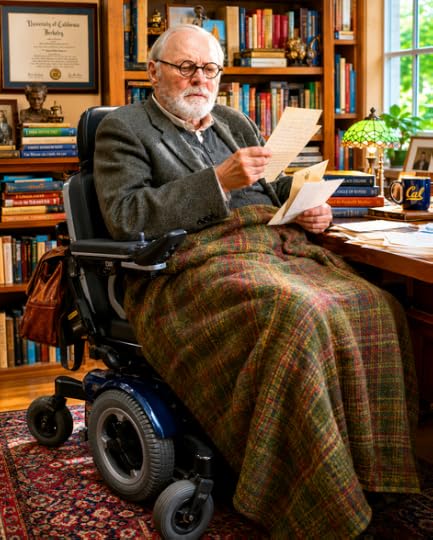
Zodiac
Cottage was the last home of Lyman's grandparents, Susan Burling Ward
and Oliver Ward. Now that Lyman has time, he's using his grandmother's
letters, papers and life as the basis of a sort of roman à clef novel.
The narrative toggles back and forth between Susan's story in the past
and Lyman's life in the present.
The book is long, so I'll just provide a brief sketch of the tale.
Susan
Burling comes from a line of Quaker farmers in Milton, New York. She's
attractive, smart and talented, and in the mid-1860s, Susan is sent to
'The School of Design for Women' in New York City, to study art.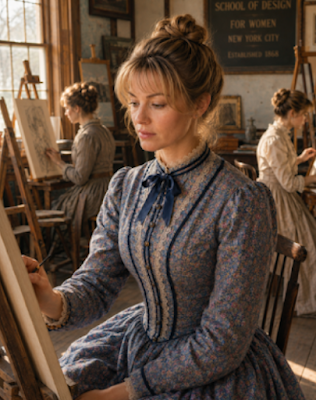
There
Susan meets Augusta Drake, a wealthy cosmopolitan girl who belongs to
the city's old aristocracy. Susan writes, "We sat together...and
scribbled quotations and remarks to each other on the margins of our
notebooks...She came up to Milton that following summer and every summer
after till there was no Milton for me...Her sharings in books and
friends were the stored honey of my girlhood." 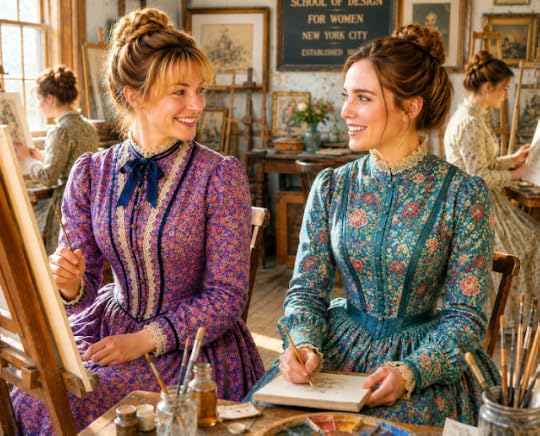
Susan
is drawn into New York's intellectual circles, where she meets renowned
editor and publisher Thomas Hudson. This leads to Susan, Augusta, and
Thomas becoming a trio of best friends, and Thomas and Augusta later
wed. Susan and Augusta remain close, and as their lives go in different
directions, the women occasionally see each other, and correspond for
the next half-century.
The story of Lyman's grandparents begins
as follows: Susan is a 21-year-old budding artist and writer in 1868,
when she meets Oliver Ward at a New Year's party. Oliver explains he was
an engineering student at Yale University, but an eye problem took him
out of school for two years. By then Oliver's class had graduated and he
chose not to return to school. Instead, Oliver is going out West to get
practical experience in engineering, mining, and surveying, which he
plans to make a career. 
Susan
and Oliver correspond for the next five or six years while Oliver is
working in California, and an understanding develops. Oliver comes East
to visit on occasion, and the couple finally wed in February 1876.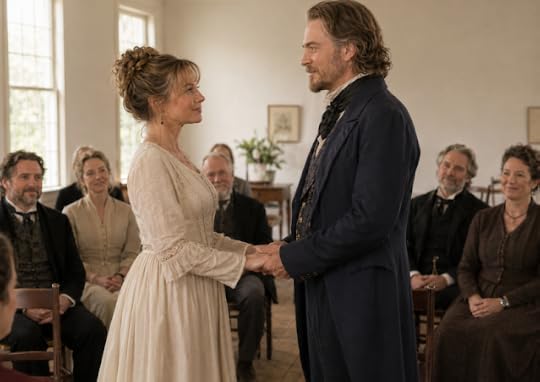
Oliver
then returns West, where he's Resident Manager of the New Almaden
mercury mine, near San José. It takes some time for Oliver to renovate a
cottage, and Susan finally sets out to join him in July 1876, bringing a
servant girl named Lizzie and Lizzie's baby.
Susan's mental
picture of the marriage is that for perhaps two years she and Oliver
would live in the West while he established himself. They would then
return East, live near her friends Augusta and Thomas Hudson, and the
two families would be great friends. Of course, nothing like that
happened.
In a nutshell, Lyman thinks of his grandmother's
married life as follows: "A Quaker lady of high principles, the wife of a
not-very-successful engineer whom you supported through years of
delayed hope, you lived in exile, wrote it, drew it - New Almaden, Santa
Cruz, Leadville, Michoacán, the Snake River Valley, the deep quartz
mines right under this house - and you stayed a cultural snob through it
all. Even when you lived in a field camp in a canyon, your children had
a governess no less, unquestionably the only one in Idaho. The dream
you had for your children was a dream of Eastern civilization." 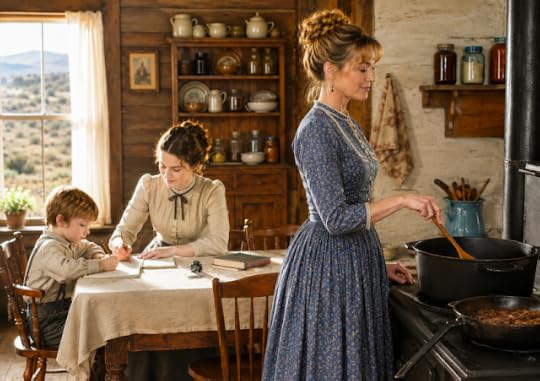
In the course of the narrative, we follow Susan's arduous journey through her long life.
As
an example, here are some snippets of newlywed Susan's trek West with
her servant girl: After a week-long journey on a transcontinental train
to California, where Oliver meets them, Susan, Lizzie and Lizzie's baby
must take further transportation to the mercury mine.
"Nothing
on the trip to New Almaden next day modified [Susan's] understanding
that her lot at first would be hardship. It was intensely hot, the
valley roads seen through the train windows boiled with white dust,
Lizzie's usually silent baby cried and would not be comforted. In San
José a stage with black leather curtains waited; they were the only
passengers. But her anticipation of a romantic Bret Harte [writer/poet]
stage ride lasted only minutes. Dust engulfed them. She had Oliver draw
the curtains, but then the heat was so great they suffered a slow boil.
After three minutes she had Oliver open the curtains again halfway. They
were thus insured both heat and dust, and were almost entirely cut off
from the view."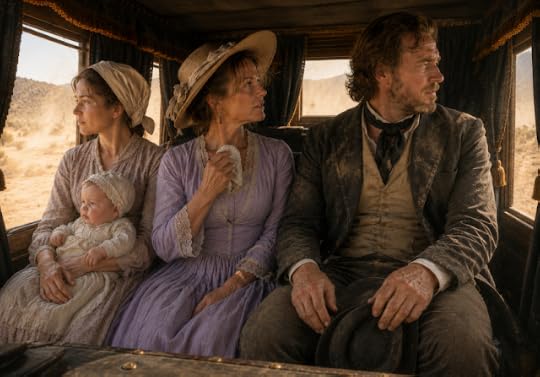
Still,
Oliver was not above making jokes, and when Susan - referring to their
home - asked "Where do we get our water?", Oliver responded, "Why, the
housewife carries it from the spring. It's only a half mile up the
hill."
When the passengers finally reached the campsite in New
Almaden, "The whole place had the air of having been dumped down the
hillside-steep streets, houses at every angle white and incongruous or
unpainted and shabby. Wash hung everywhere, the vacant lots were
littered with cans and trash, dogs prowled and children screamed. At the
water tank they slowed to pass through a reluctantly parting densely
staring tangle of men, boys, teamsters, cows, donkeys, mules."
Susan
makes the best of it by imagining the pictures she can can draw and the
stories she can write, but it's a shock for a fastidious lady from the
East.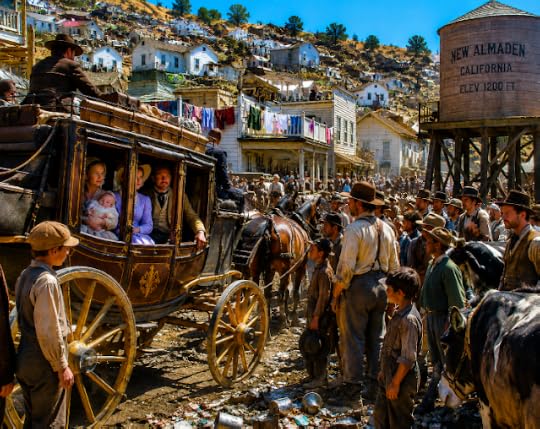
Even more harrowing is a trip to the silver mines of Leadville, Colorado seven or eight years later. 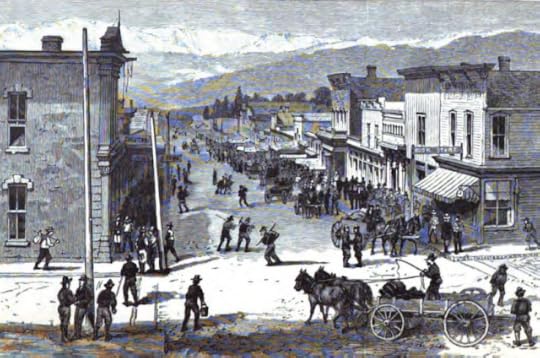
Leadville, Colorado
Susan
and Oliver have been apart for long periods because Susan feared the
places Oliver worked - like Deadwood, South Dakota - were too rough for
their son Ollie. However, Ollie is now back East recovering from
malaria, which he contracted visiting Susan's family. So Susan thinks,
"No more foolish protectiveness about Ollie, no more timorous
holding-back from sharing her husband's life."
Oliver meets
Susan at the Denver railroad station, and they head for the silver mines
of Leadville in a buggy. The trip is horrible. "At a washout...Susan
got out obediently and floundered behind the buggy while [Oliver] led
the team through." Oliver commented, "Just as well it's too dark to see.
Two wrecked rigs and three dead horses down the cliff." 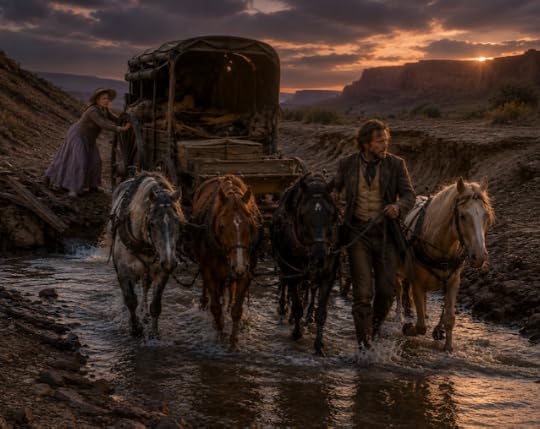
Then
a clerk has given away the hotel room Oliver reserved for five dollars,
and "With the slightest indulgence, the sagging disappointment in
Susan's muscles could become panic. Where WOULD one sleep, in this wild
place full of rough men? The stable? A hayloft or manger?" The clerk is
snippy and "Watching [Oliver], Susan saw the fury come up so suddenly in
his face that she was afraid he was going to lean over the desk and
slap the clerk."
The couple manage to get a bed in a
boardinghouse, separated from other guests' beds by muslin sheets. In
the night, Susan hears people coughing, snoring, grinding their teeth,
scolding, and yawning. "And that made [Susan] think, with failing nerve,
that whatever it was, it was to be her life. It was what she had
deliberately chosen."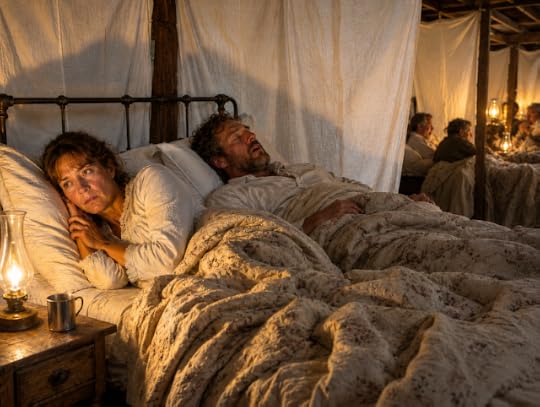
The
last leg of the trip to Leadville is worse yet. While Oliver and
Susan's buggy is navigating the edge of a cliff, a runaway stagecoach
comes around a bend and is heading straight for them. Oliver viciously
whips the horses, and "they jerked wildly in toward the cliff, among the
blocks of stone. And there was not room, [Susan] knew it with a
certainty that froze her mind. The left wheels reared up, climbed,
crashed down, climbed again; the buggy tilted so steeply that she hung
on in frantic fear of sliding straight off under the hoofs and
wheels....." By the time they're safe, "Susan sat white and trembling,
hating [Oliver's] cruelty, hating the pain and exhaustion of the sick
beast, hating the heartless mountains, the brutal West."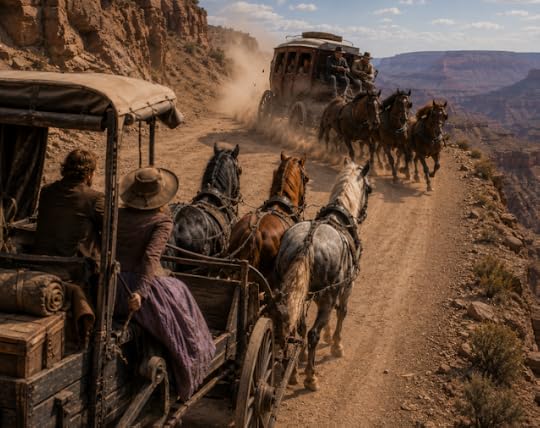
Of
course, the Wards' lives in the West aren't all doom and gloom, and
there are times Susan is happy and fulfilled. Susan has three children -
Ollie, Betsy and Agnes; she frequently sells drawings and stories to
elite Eastern publications; she loves Mexico when Oliver is posted
there; she has a literary salon in her Leadville cabin, and hosts
resident and visiting intellectuals; and more.
However,
Oliver has a character trait that, in time, has unfortunate
consequences. The 'flaw' is exemplified by the following: On their trip
to the Leadville silver mines, Oliver tells Susan about someone jumping
his claim. When Susan asks what he did about it, Oliver says he just
went to the office and picked out another lot. Susan observes, 'You're
queer, do you know? You let yourself be imposed on and cheated, and you
don't seem to care." Oliver responds, "I don't like trouble, not about
anything small. I've got too ugly a temper when I do get mad, so I try
not to get mad....I hold grudges."
The thing is, Oliver is
trusting and naive, is cheated by people again and again, and does
nothing about it. Eventually, Oliver's 'negligence' ruins plans Susan
has been making for years, to bring her sister Bessie's family to the
West. This has sad consequences all around. 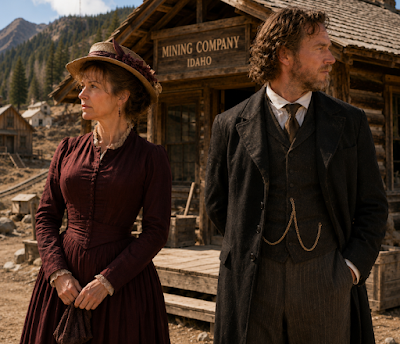
The
novel contains much more about the Wards and their work, families,
friends, and acquaintances. All in all, it's a fascinating picture of
the settling of the old West.
Now, I'll say a few words about Lyman Ward's part of the novel.
Lyman
was raised by Susan and Oliver Ward in Zodiac Cottage, and is now
learning more about their history. He writes, "My mother died when I was
two, my father [Ollie] was a silent and difficult man: I grew up my
grandparents' child. As those things went in Grass Valley, I also grew
up privileged, son of the superintendent of the Zodiac [gold mine] and
grandson of the general manager. Every child I played with came from a
family that worked for mine....Grandmother deferred to my father
[Ollie], seemed almost to fear him. Certainly she assumed the blame for
the taciturnity that made him formidable to deal with, and certainly she
saw in me a second chance to raise up an ideal gentleman."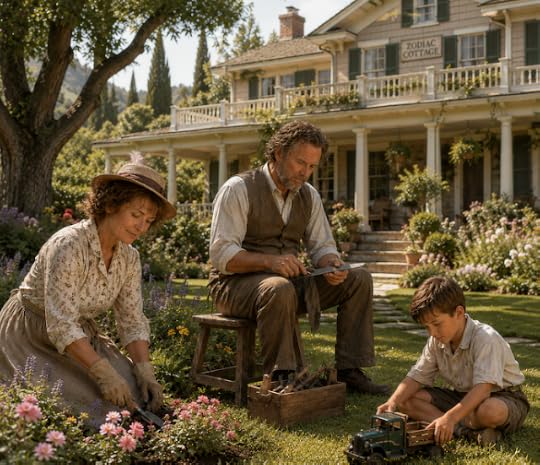
Lyman
is now in constant pain from his bone disease and amputee stump, and he
frequently pops aspirin and drinks bourbon. Lyman's wife Ellen left him
for the surgeon who amputated his leg, and Lyman understandably holds a
grudge. Lyman's son Rodman, a Berkeley sociology professor and 'modern
thinker', wants his father to move to an assisted living facility for
his own good.
Lyman is out of tune with the hippie culture that's
invaded Berkeley, exemplified by his temporary assistant Shelley (the
daughter of Lyman's caretaker Ada). Shelley helps Lyman sort his
grandmother's papers and types the recordings he makes for his books. As
Shelley gets more comfortable with Lyman, she gives unwanted opinions,
asks nosy questions, and converses about things that make Lyman
uncomfortable, like an orgy she attended. 🫨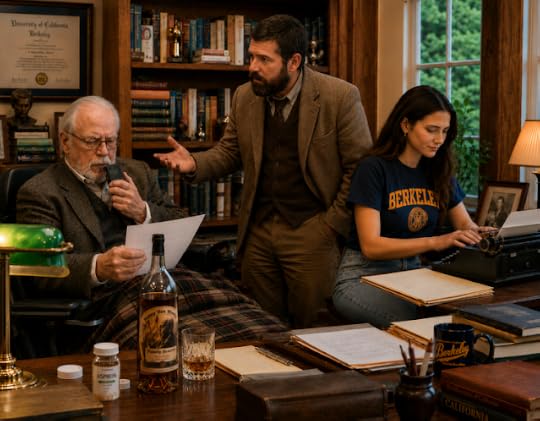
There
was some controversy about whether Angle of Repose deserved the
Pulitzer Prize, but there's often controversy about Pulitzer selections.
For me, the novel is an engrossing, well-written book that adds to the
picture of the Old West gleaned from television, streaming, and movies.
It's fascinating to see the region from the point of view of an elite
Eastern lady rather than lawmen, gunslingers, gold rush immigrants,
Chinese workers, saloon women, and so on. I highly recommend the book.
Rating: 4.5 stars

No comments:
Post a Comment