
I previously read journalist Robert Kolker's book Hidden Valley Road: Inside the Mind of an American Family,
about the Galvin family of Colorado Springs, Colorado. Six sons (out of
twelve children) were diagnosed with schizophrenia, and Kolker tells
the Galvins' story, including the search for genetic markers for the
disease, and the family's contribution to the study of mental illness.
The Galvin family
In
'The Vanishing Family', Kolker relates the story of another family that
carries the gene for a hereditary illness, in this case frontotemporal
dementia. It took decades for the clan to understand their plight, and
Kolker relates their tale step by harrowing step.
For privacy, Kolker uses only first names.
Irish-Catholic
couple Ollie and Jean were born in the late 1920s, married in 1950, and
settled in a Missouri suburb called Webster Groves. Over the next 15
years, Jean became the stay-at-home mom of seven children, and Ollie
worked at a series of engineering jobs, hoping to start his own business
some day.
By
1967, financial difficulties and job opportunities led Ollie and Jean
to settle in Pleasant Hills, Pennsylvania, and they eventually had a
total of nine children: Kathy, Christy, Sue, Dutch, Mary, Peggy, Scott,
Jenny, and Barb.
Kolker
writes, "Jean was something of a wonder, filled with optimism and
energy, reading, gardening, and playing bridge with Ollie and their
friends. She shopped for the food on a strict budget, making the
calculations and lists in her head, and cooked everything for the
family. She made her own donuts and pizza from scratch, and served up
enchiladas when they were still considered an exotic foreign dish." 
By
her late forties, however, Jean became increasingly withdrawn and
depressed. As time passed, Jean stopped dressing up every day like she
used to to; quit going to the hair salon; neglected her hygiene; became
silent; drank heavily; didn't pay bills; played solitaire and watched
game shows all day; paid little attention to the children; said yes to
every sales call, resulting in multiple subscriptions to the same
magazines; and generally made poor decisions.
The
changes were obvious to Ollie, the children, and the neighbors, who
usually attributed Jean's behavior to Ollie's flagrant cheating. 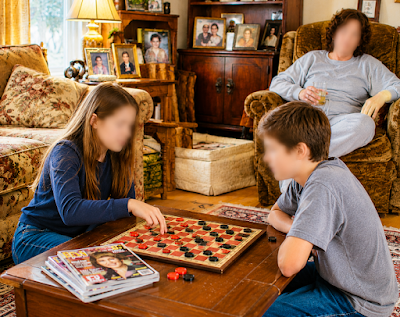
Jean
continued to decline for two decades, until she neglected her breast
cancer for so long she couldn't be successfully treated. Jean died in
1990.
As it turns out, Jean was the first victim (in the
immediate family) of frontotemporal dementia. This wasn't diagnosed
until the late 1990s, however, after Ollie and Jean's daughter Christy
developed symptoms similar to those of her mother. Christy was a
successful marketing executive, wife, and mother before she fell ill,
but her life fell apart afterwards.
Frontotemporal dementia
(FTD) is an illness in which the brain's frontal and temporal lobes
gradually degenerate, causing people to lose their personality,
judgment, language, and self-control. Symptoms usually begin in a
victim's forties, and unlike 'old-age' dementia, patients don't lose
their memories.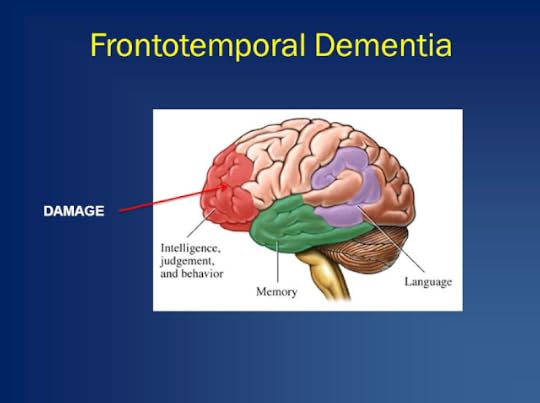
Over
time, five of Ollie and Jean's nine children developed FTD. Some family
members submitted blood/saliva samples for genetic testing, and
researchers found their FTD resulted from an autosomal dominant gene
called V337M, which causes tau mutations (tangles) in brain proteins. An
autosomal dominant gene means there's a 50:50 chance a victim will pass
the gene to their children. 
Tau mutations caused by V337M
In
Ollie and Jean's clan, Jean had the genetic defect, which she passed to
five of her children, who then passed it to some of their offspring.
The exact number of victims isn't known, since some family members
haven't been tested (by their own choice).
Kolker provides
mini-biographies of all nine siblings, most of whom went on to college;
got married and had children; and had successful careers. The victims
who developed FTD couldn't work (or lost their jobs) after they fell
ill, and were unable to take care of themselves. Sibling Sue, who
remained healthy, stepped up and took care of some family members,
especially Christy.
Kolker describes a typical day for Sue and
Christy in their later years. 'Sue helps Christy with everything,
coaxing her to the toilet and then the shower. Laundry is a constant.
Christy wears adult diapers, but has accidents that call for a change of
clothes, about five or six changes a day. Christy's favorite spot in
the house is an easy chair in the TV area. The chair has a big leather
belt, to keep Christy from roaming when Sue isn't watching. Because of
Christy's compulsive overeating, Sue has to padlock the refrigerator,
lock the pantry, and make all the meals. Sue is on constant alert,
whether she and Christy are inside the house, outside taking a walk, or
doing other things. 
There's
no cure for FTD, and until recently, minimal research about the
condition. Kolker describes the formation of 'The Association for
Frontotemporal Degeneration' (AFTD), whose members - including youngest
sibling Barb - lobby politicians, scientists, pharmaceutical companies,
etc. to support studies of FTD, with the aim of finding a treatment or
cure.

In
addition to telling the story of Ollie and Jean's family, Kolker writes
about doctors and scientists who added to our knowledge of the brain,
and provided information about the causes of psychiatric syndromes and
dementia.
Examples include:
➽ Dr. Arnold Pick - In the
early 20th century, Pick was the director of the psychiatric hospital at
the University of Prague in Czechoslovakia. During autopsies of
patients with language and/or behavior problems, Pick observed atrophy
of the brain's frontal and temporal lobes. For many years, this was
called Pick's disease. It's now known to be a type of FTD (but not the
kind in Ollie and Jean's family).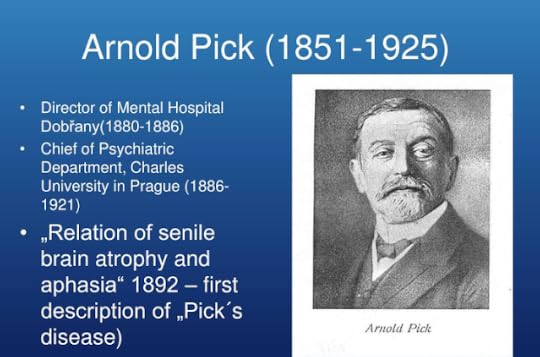
➽
Dr. Alois Alzheimer - Also in the early 20th century, Alzheimer was a
German psychiatrist and brain researcher. Alzheimer had the opportunity
to study the brain of Auguste D., a woman who lost her memory, forgot
her way around her apartment, thought someone was trying to kill her,
and descended into total delirium. When Auguste D. died, Alzheimer found
'plaques and tangles' in her brain, and this type of dementia was named
Alzheimer's disease.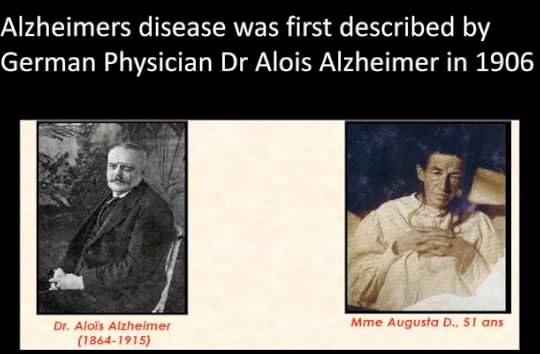
➽
Sir John Hardy - Hardy is a British neurogeneticist, currently at the
National Institutes of Health. Hardy identified a mutation associated
with Alzheimer's disease.
Sir John Hardy
Kolker
also provides anecdotes about unusual neurological cases. One of the
most famous is Phineas Gage. In 1848, at the age of 25, Gage was a
dependable construction foreman working on a job site. After an
explosion, a long iron rod sliced through Gage's brain, and he became impulsive, profane, unreliable, and unable to plan ahead. The
brain injury changed Gage's personality, and showed that specific parts
of the brain control behavior.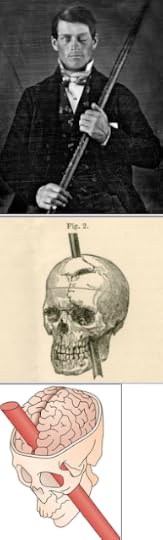
Phineas Gage
The
book is informative, interesting, and draws attention to an illness
that might be treatable with a DNA tweak. Highly recommended.
Thanks to Netgalley, Robert Kolker, and Doubleday for an ARC of the book.
Rating: 4 stars

No comments:
Post a Comment