
Steve Brusatte is an American paleontologist, dinosaur hunter, science
writer, professor, and consultant for Jurassic World. Brusatte has
written books about mammals and dinosaurs, and this discourse on birds
adds to his impressive paleontology oeuvre.
Rather than pen a dry
science chronicle, Brusatte laces his book with fanciful zoological
scenarios and anecdotes about researchers, which makes the book fun as
well as informative. 
Author Steve Brusatte
Brusatte
starts out with an observation that might surprise some people.
"Dinosaurs, those great icons of extinction, aren't really dead. Birds
are dinosaurs. That is the evolutionary story I am going to tell in this
book. The complete journey of birds, from their origins among small
carnivorous dinosaurs, through the twists and turns of volcanic
eruptions and asteroid impacts and drifting continents, to the more than
ten thousand species that persist today." 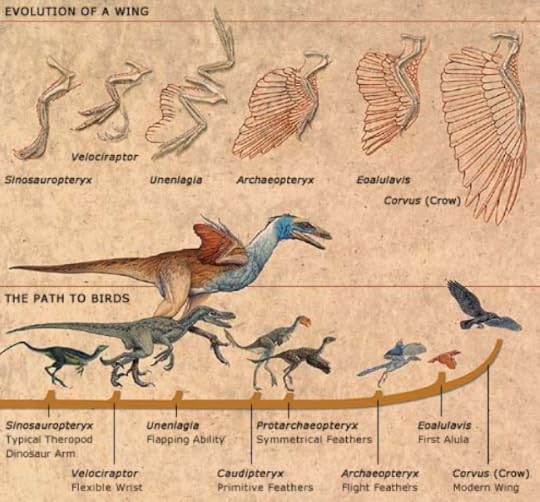
There's
been debate about the dinosaur-bird connection since the mid-1800s, but
the case was substantially proven in the 1960s when Yale professor John
Ostrum found fossils from a dinosaur along the Wyoming-Montana border.
Ostrum named it Deinonychus, and it had a neck, pelvis, head, and arms
that Ostrum had seen before....in birds. 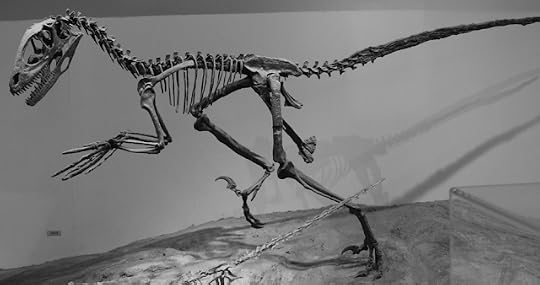
Deinonychus
Deinonychus
inspired Ostrum to take a closer look at Archaeopteryx, the extinct
Jurassic bird first discovered in 1861. What Ostrum saw now astounded
him. Archaeopteryx looked just like a coelurosaur - a small predatory
dinosaur. 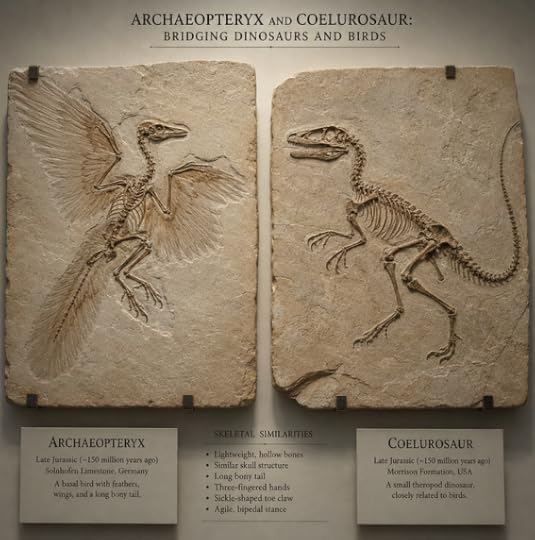
In
this book, Brusatte explains in detail how dinosaur traits morphed into
what we think of as bird characteristics. He also provides proof of
dinosaur-bird associations discovered by researchers and experts. I'll
give a few examples for the general reader, but keep in mind Brusatte's
explanations are MUCH MORE extensive, scientific and detailed.
⚫ The link between dinosaur scales and bird feathers
Both
reptile scales and bird feathers are made of corneous beta-proteins
(CPB), and research with embryos proves that bird feathers are basically
elaborate scales that developed from the substances that make up
reptile claws. In fact, many dinosaurs had feathers, as seen in fossils
found in China and elsewhere. Feathers did not evolve for flight. It's
much more likely feathers originated for insulation and became more
elaborate/colorful for sexual selection (attracting mates). Only later,
did feathered wings evolve, and become airfoils used for flying.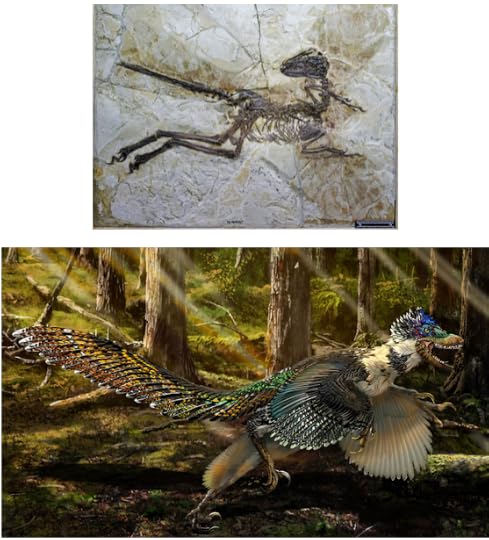
Fossil of feathered dinosaur Zhenyuanlong suni found in China (top); Artist's depiction of Zhenyuanlong suni (bottom)
⚫ Some dinosaur embryos are distinctly bird-like
In
2019, a fossilized dinosaur egg containing an embryo was discovered in
China. Brusatte could tell from the shape of the skull that it was a
type of small coelurosaur theropod - one of the feathered dinosaurs. As
Brusatte's group analyzed the fossil - which they named Baby Yingliang -
they felt like they were studying a bird. The fossil egg had the shape
of a chicken egg, and the posture of the embryo was distinctly birdlike.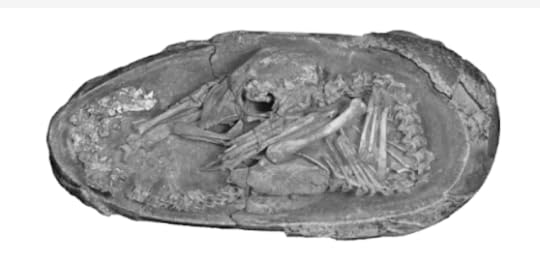
Fossilized dinosaur egg containing Baby Yingliang
Brusatte
points out that much about the eggs, reproduction, and parenting
strategies of coelurosaurs were birdlike. He notes, "If you squint at
Baby Yingliang's spinal cord, you'll notice minuscule holes that pierce
the vertebrae and expand inside the bones as caverns. These bones are
largely hollow, as are many bones in modern birds.
⚫ The evolution of flight
Archaeopteryx
had wings, but could it fly? Archaeopteryx had asymmetrical feathers, a
sign that it had lift-providing wings that could withstand the rigors
of propulsion through the air. Also, observation of Archaeopteryx
skeletons with intense X-rays show that the density of the wing bones
and the thinness of their walls correspond to those of modern-day birds
that flap their wings to fly in bursts, for short distances. So
Archaeopteryx probably flew.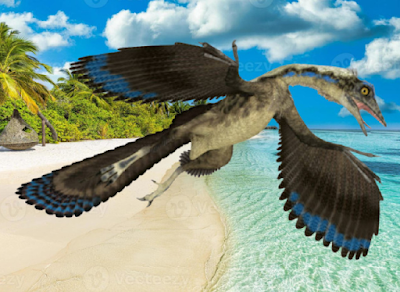
There
are two opposing theories, however, about how dinosaur flight evolved.
One group posits flight evolved from the ground up, as fast-running
dinosaurs used their proto-wings to catch insects, or leap onto their
prey, or turn, etc. Then they somehow started to generate a little lift
as well, and took to the skies.
The opposing group prefers a
trees-down scenario. These proponents suggest the proto-wings were used
by tree-dwelling dinosaurs to extend jumps and provide stability as they
leapt between branches, which eventually led to flight.
To
resolve the controversy, scientists will need to find fossils of the
very first birds, to study the structure of the wings. In any case, much
is already known about the evolution of wings, and Brusatte discusses
this in some detail.
⚫ From reptile teeth to bird beaks
The
most recent common ancestor of modern birds, called crown group birds,
lived in the late Cretaceous (around 65 million years ago). A late
Cretaceous avian fossil named Asteriornis (aka Wonderchicken), looks
something like a half-duck, half-chicken with a large toothless beak.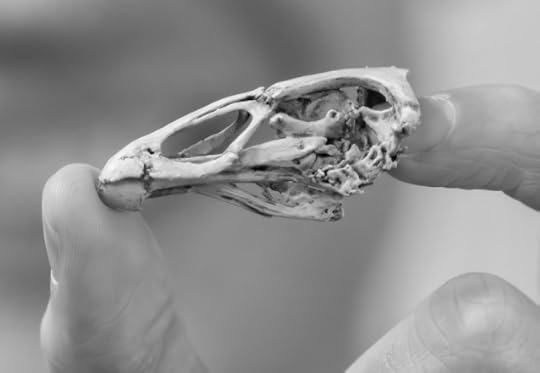
The skull of the Wonderchicken
Brusatte
writes that the late Cretaceous appearance of the Wonderchicken marks
the appearance of full-on modern-style birds. He notes, "They changed
their teeth for beaks. Now their entire body was that of a
bird...Different Cretaceous birds probably lost their teeth for various
reasons...Some might have adapted to eat new foods, like nuts or crunchy
insects, which could better be crushed by a beak...others might have
[discarded] a bit of extra weight from....useless teeth, to unburden
themselves further for flying...All it probably took was a few genetic
mutations, and the teeth would disappear, leaving the jaws free for new
functions." For interested readers, Brusatte provides a thorough
discussion of the evolution of the bird beak.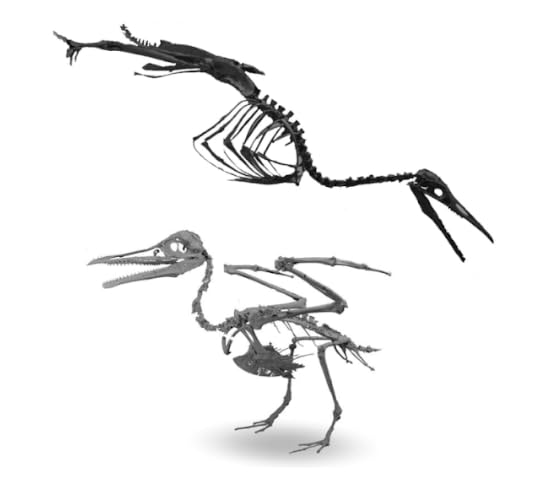
Nearly modern Cretaceous birds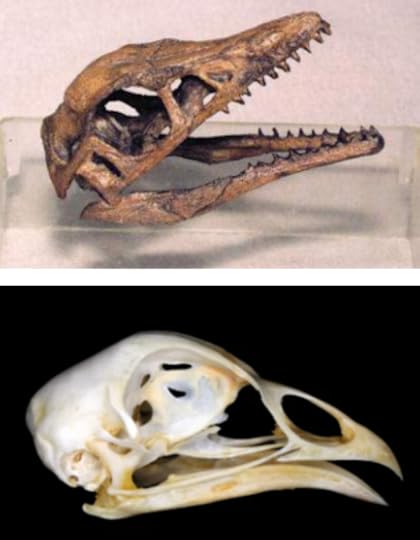
Archaeopteryx beak with teeth (top); Modern fowl beak with no teeth (bottom)
⚫ Birds survive the extinction event at the Cretaceous-Paleogene (K-P) Boundary
Sixty-six
million years ago, an asteroid about six miles (10 kilometers) wide
smashed into what is now the Yucatán Peninsula of Mexico. It smashed
with colossal force, "triggered tsunamis and earthquakes, propelled
hurricane-force winds, and activated volcanoes. It turned the atmosphere
hotter than an oven, sparking wildfires and liquidating rocks that
cooled and fell back down as glass....The dirt and dust from the
collision, and the grime and soot from the fires, drifted into the
atmosphere and blocked out the sun. It was a global nuclear winter." 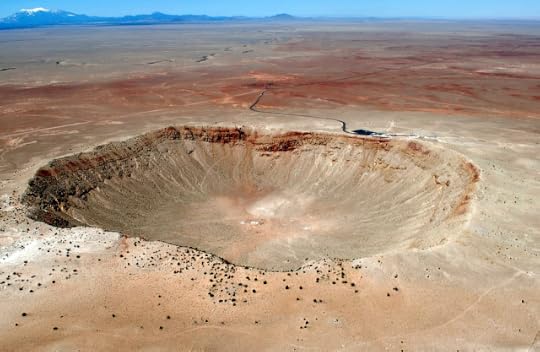
Chicxulub crater resulting from the meteorite strike
Most
plants and animals died in the mass extinction event, including
non-avian dinosaurs. But some birds made it through. Scientists
speculate the survivors were ground birds that ate seeds, which can
remain in the soil for decades. 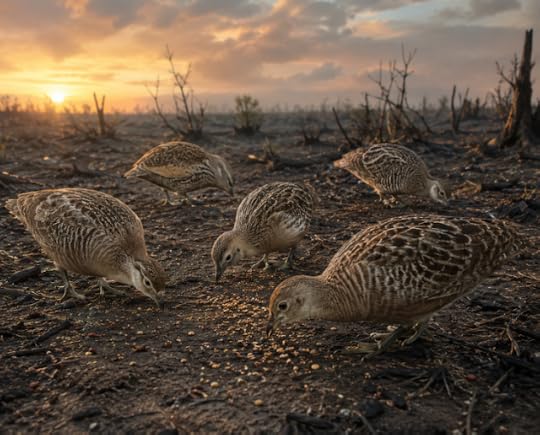
Scientists speculate some ground birds survived the extinction event at the K-P Boundary
Brusatte
writes, "No matter how they did it, once some crown group birds made it
through the nuclear winter and greeted the returning sun, they would
have looked out at an empty world. Most niches in the food webs were
vacant...Opportunities abounded. And these birds took advantage - they
diversified with gusto, evolving into many new species, reconquering the
trees, expanding into new environments, and in some cases, moving into
the niches of their departed dinosaur brethren."
Brusatte
proceeds with an extensive discussion of bird evolution from the
Paleogene Era forward, a must-read for bird aficionados. This includes
references to the 'eighth continent' Zealandia, most of which is now
underwater, with New Caledonia and New Zealand poking up. These regions
are known for their large flightless birds, called rattites.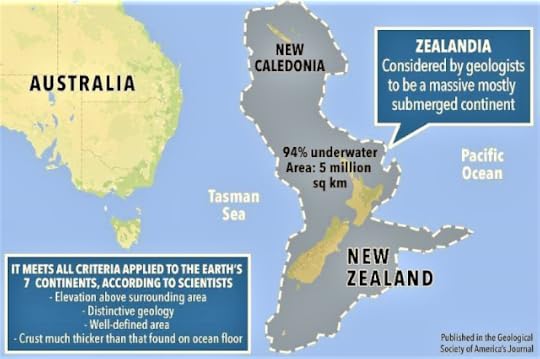
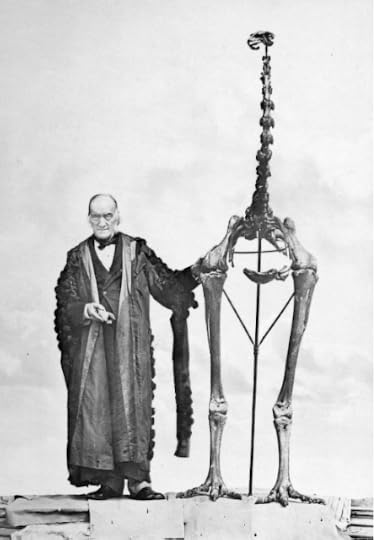
Richard Owen, 19th century English biologist and paleontologist, with the skeleton of a moa from New Zealand
In
a fun anecdote, Brusatte recalls, "One of my proudest moments as a
father was when my boy Anthony, who was four at the time, proved himself
to [paleontologist] Jack Horner." Jack asked Anthony, 'Son, what's your
favorite dinosaur?' And Anthony immediately said 'penguins.'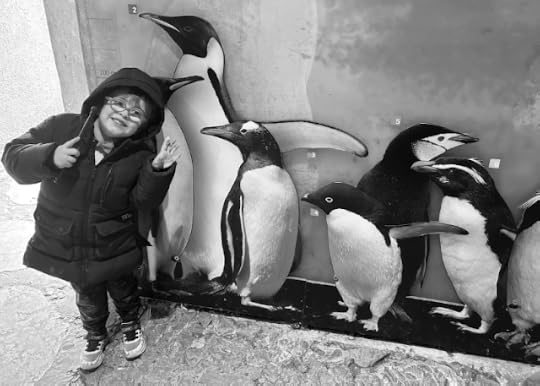
Anthony Brusatte, at five-years-old, next to a montage of penguins at the Prague Zoo
When
Anthony heard there were gigantic penguins that lived long ago - taller
and heavier than his Dad - he was mesmerized, and informed much of
Edinburgh's under-six population. 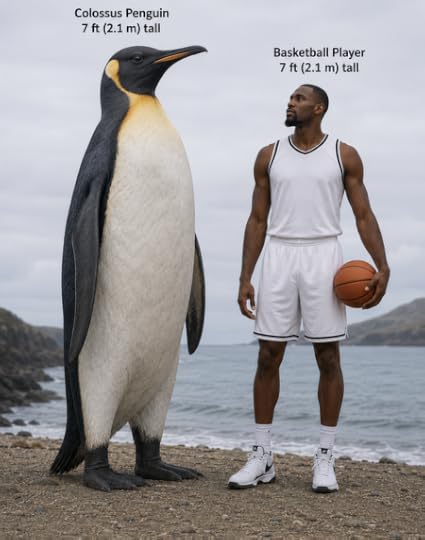
The ancient colossus penguin was as tall as a basketball player
⚫Bird Intelligence
Brusatte
observes, "Birds are smart. Many use tools, recognize themselves in
mirrors, have sharp memories, and can plan ahead. And some, like crows
and parrots, boast problem-solving skills otherwise seen only in
primates like us."
How is this possible? The basic computational
unit of the brain is the neuron, and scientists discovered that bird
brains are packed with neurons. "For example, a goldcrest, Europe's
smallest bird at a mere sixth of an once (4.5 grams), has 164 million
neurons, double that of a two-hundred-pound (90 kg) Nile crocodile. 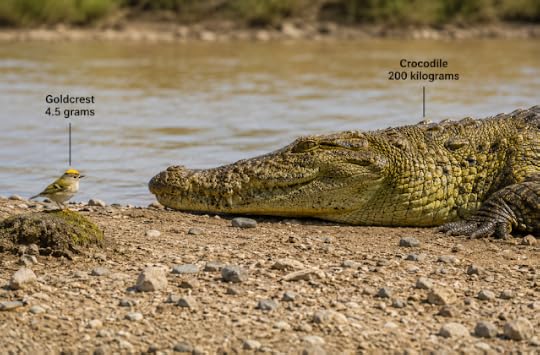
In
fact, "pound for pound, [birds] have more cognitive power than mammals,
or indeed any other animal." Brusatte expounds on the evolution of bird
brains, and the remarkable abilities of these feathered creatures.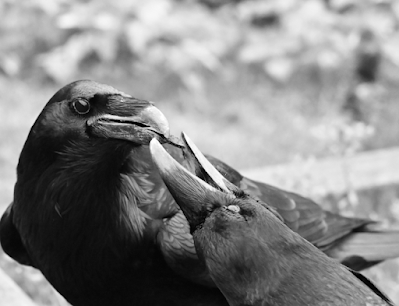
A pair of adult ravens transferring a tool between them
⚫ The Future of Birds
Brusatte
notes that birds are not doing well. Many modern bird species have gone
extinct, and it's the fault of humans. Brusatte writes, "The reasons
are varied. We hunt birds, clear their habitats to make farmland and
cities, poison them with pesticides, and introduce rats and dogs and
other invasive species that crowd them out. And especially over the past
couple of centuries, we've been changing the climate so quickly and
thoroughly that some birds struggle to cope." It's sad. 😪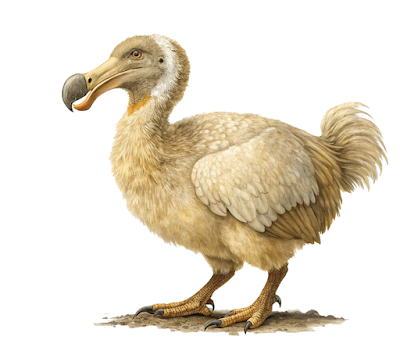
The dodo went extinct by the late 17th century
At
almost 450 pages, Brusatte covers MUCH MORE territory in the book,
which also contains informative endnotes and references. Photos enhance
the narrative, and Brusatte's copious acknowledgments add a warm note.
I found the book informative and enjoyable, and highly recommend it.
Thanks to Netgalley, Steve Brusatte, and Mariner Books for an ARC of the book.
Rating: 4.5 stars

No comments:
Post a Comment